






LightningChart Ichimoku Cloud: components, calculations, and interpreation
ArticleLearn more about the components of the Ichimoku Cloud and learn how to read and interpret it.
Written by a human | Updated on April 22nd, 2025
Introduction to Ichimoku Cloud
Ichimoku Cloud is a technical indicator that consists of five separate indicator lines. The purpose of the indicator is to provide information about support and resistance levels. These resistance levels are points where demand matches the supply and prices stop falling or rising.
Ichimoku Cloud also provides information about momentum and the current trend in one package. Ichimoku Cloud is also used to generate trading signals.
There are five main components for the Ichimoku Cloud indicator:

●Tenkan-sen (Conversion Line) is based on the highest high and the lowest low over a set number of time periods. It is used to determine support and resistance levels and to provide signals about price reversals.
●Kijun-sen (Base Line) is similar to Tenkan-sen but is based on more time periods, usually 26. It again provides information about support and resistance levels but can also be used to confirm trend changes.
●Chikou Span (Lagging Span) is based on the current close value plotted several periods in the past. This can be used to identify possible support and resistance levels.
●Senkou Span A (Leading Span A) uses Tenkan-sen and Kijun-sen values in its calculations and plots the result several time periods ahead. It forms the actual “cloud” part with Senkou Span B.
●Senkou Span B (Leading Span B) is calculated similarly to Tenkan-sen and Kijun-sen but uses even more time periods, usually 52. Like Senkou Span A, it is plotted several periods ahead of time and is used to form the “cloud” part of the indicator.
The cloud component of the Ichimoku Cloud refers to the area between Senkou Spans A and B. In most charts, this area is colored: green if Senkou Span A is above Senkou Span B, and red if B is above A.
Ichimoku Cloud was developed by Goichi Hosoda in the 60s. Ichimoku translates to “one look”, which means that one view of the chart is enough to determine support levels, the current trend, etc.

The colored cloud area can be seen between the Senkou Span lines. The Ichimoku Cloud indicator is a built-in feature of the LightningChart JS Trader.
Ichimoku Cloud Calculations
Tenkan-sen & Kijun-sen calculations
Tenkan-sen = (highest high of n periods + lowest low of n periods) / 2
Kijun-sen = (highest high of n periods + lowest low of n periods) / 2
Where n is the number of past-time periods to look for the highest and lowest values. Notice that for Tenkan-sen, n is usually 9 while for Kijun-sen, n is usually 26.
Chikou-Span calculations
Chikou-Span = Current close shifted back n number of time periods
Where the default value of n is 26.
Senkou Span A calculations
Senkou Span A = (Tenkan-sen value + Kijun-sen value) / 2 shifted forward x number of time periods
Where x is usually 26
Senkou Span B calculations
Senkou Span B = (highest high of n periods + lowest low of n periods) / 2 shifted forward x number of time periods
Where n is the number of past periods to look for the highest and lowest values, usually 52, the default value of x is again 26.
Interpretation of Ichimoku Cloud
At first glance, Ichimoku Cloud can seem like a complicated mess. However, when you learn what all the lines mean, it is quite simple because apart from Chikou-Span, the lines are just moving averages.
The relationship between Tenkan-sen and Kijun-sen is one of the main aspects of Ichimoku Cloud. Tenkan-sen is an average that is based on fewer time periods than Kijun-sen’s, thus responding to price changes faster. Therefore, traders should watch when Tenkan-sen moves above or below Kijun-sen as this is a signal for an uptrend or a downtrend. Crossovers between the other lines can be signals as well.
The colored cloud area also plays a key role when interpreting the indicator. In general, when the price is above the cloud, the current trend is upward as the prices are rising, and when the price is below the cloud, the trend is downward as the prices are falling. If the price is within the cloud, there is either no clear trend or the trend is in the transition phase.
The color of the cloud can be used to confirm the trend: green color (Senkou Span A above Senkou Span B) means an uptrend while red color (B above A) means a downtrend. It should be noted that sometimes the color changes happen with a delay and therefore aren’t reliable sources of trends alone.

The current trends can be spotted by looking at when the price moves above the Ichimoku cloud in an uptrend or below the cloud in a downtrend. Respectively, Tenkan-sen (blue line) above Kijun-sen (red line) signals an uptrend and vice versa. The cloud colors change with delay, thus not matching the trend in all cases.
Ichimoku Cloud is often used to generate trade signals. For example, when the price moves above the cloud, that could be a signal to buy. This signal is strengthened if at the same time, the cloud is green or if Tenkan-sen moves above Kijun-sen.
Respectively, a selling signal can be indicated by the price dropping below the cloud. Again, a red cloud or Tenkan-sen below Kijun-sen strengthens the signal.
It should also be noted that since both Senkou Spans are plotted several time periods ahead, Ichimoku Cloud can be used to predict future support and resistance levels. Traders can use this information to estimate where the prices are likely to stop rising or falling and buy or sell accordingly.
However, as always, Ichimoku Cloud is best used together with other technical indicators to minimize the risks even though it is designed to show all the necessary information on its own.
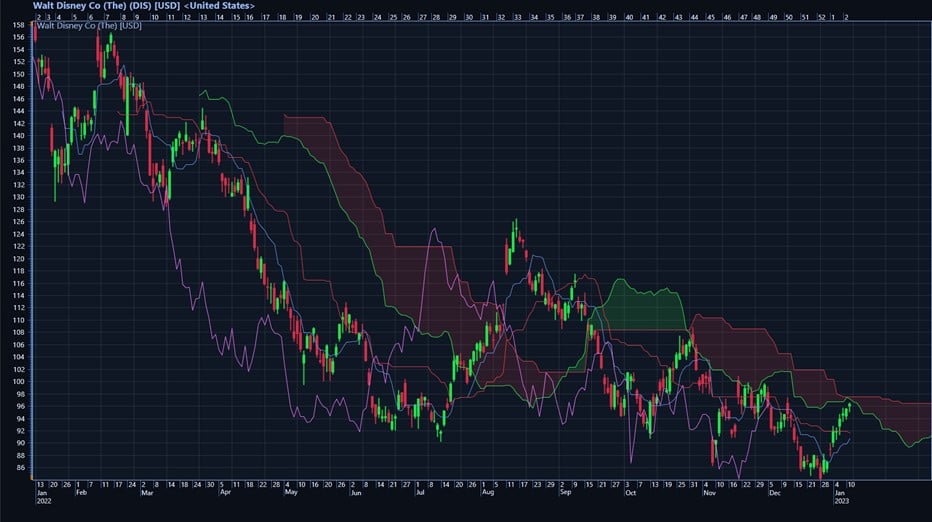
The latest prices are below the cloud while Kijun-sen is above Tenkan-sen. However, the prices are nearing the cloud which seems to stay quite flat in the near future. A buy signal might happen soon.
Ichimoku Cloud Component
Ichimoku Cloud is available as a built-in feature in the new LightningChart JS Trader. The LightningChart JS Trader is a revolutionary Technical Analysis chart library that can be integrated into JavaScript-based software applications.
LightningChart JS Trader arrives as the best trading charts solution for developing financial and stock trading applications that require sufficient processing power to run even microsecond-level stock price monitoring.
This is a technical analysis chart library that runs only at the fastest and highest performance powered by its parent library LightningChart JS. Technical indicators such as the XABCD Pattern are included in the LightningChart JS Trader but the list is vast featuring more than 100 technical indicators of types such as:
- Envelopes
- Moving Averages
- Oscillators for Money Flow
- Oscillators for Price
- Statistics
- Trend Indicators
- Volatility and a lot more
LightningChart JS Trader comes also with built-in drawing tools, several UI themes for customization, compare symbols, and a full library of compatible 2D and 3D charts.
Conclusion
In this article, we focused on understanding the five main components of the Ichimoku Cloud technical indicator. These components are Tenkan-Sen, Kijun-Sen, Chikou Span, Senkou Span A, and Senkou Span B. These components are also known as Conversion Line, Base Line, Lagging Span, Leading Span A, and Leading Span B, respectively.
I also looked into the formulas for each component calculation and interpreted how to ready the Ichimoku Cloud. As earlier mentioned, the Ichimoku Cloud indicator may seem complicated but starting from understanding what the lines mean could help you get more acquainted with the interpretation of values.
I hope you found this article useful. Thanks for reading.

Lasse Portin
Senior Developer


Continue learning with LightningChart
Horizontal Bar Chart of Russia-Ukraine War Weaponry Data
Written by a human | Updated on April 10th, 2025 JavaScript Horizontal Bar Chart In this article, we aim to respectfully create a JavaScript horizontal bar chart that simulates the weaponry usage on recent war conflicts. While the data have been taken from Kaggle and...
Create a vibration charts application with 2D & 3D spectrograms
Written by a human | Updated on April 10th, 2025JS Spectrogram ApplicationHello, in this article we will create a JS dashboard with 2D and 3D spectrogram charts. The purpose of creating this project is to explain how to create a vibration analysis application that...
Ionic app development
Written by a human | Updated on April 10th, 2025Beginning Ionic App Development with Capacitor, Angular & LightningChart JS [This is the second part of the article "Data Visualization with Ionic Capacitor, Angular & JS Charts (Part 1)"] In the previous...



If you have any questions, feel free to contact us!


©LightningChart Ltd 2026. All rights reserved.