






Data VisualizationUnderstanding Data Volume Growth in Big Data | LightningChart
ArticleLearn more about the implications and characteristics of Volume in Big Data.
Written by a human | Updated on April 14th, 2025
Volume in Big Data
Big data is a prevalent term and is even used by those who associate big data with just a lot of data points. Big data is not a new term, and the collection of information has always been there. Simply put, every system can create new data, for instance, individuals and businesses worldwide are exponentially growing the amount of data they generate. Yet when we refer to volume in big data it does not only refer to just a large dataset.
As of now, is essential for businesses to store, process, and analyze their data effectively for managerial decision-making. In this discussion, I will focus on one of the main characteristics of volume in Big Data. Volume in big data comes as a part of the theoretical characteristics that help us understand what is big data. Mostly, data experts refer to these characteristics as the 4 (or 5) Vs of big data: Volume, Velocity, Variety, and Veracity.
Why is Volume in Big Data important?
By 2022, there were about 64.2 zettabytes of new data generated and according to Statista forecast by the end of 2023, this number will be 120 ZB. There is undoubtedly growth in the amount of data generated today.
Though the latter forecast includes all types of captured, copied, or consumed data, this gives a hint of the type of systems that we should be able to count on to process large amounts of data.

Not all data processing methods or components are suitable for modern applications that handle a high volume of data. The amount of data generated today is much larger than what traditional methods were designed to handle.
The Internet, social media, and the Internet of Things (IoT) have all grown rapidly. This leads to a huge production of data every second. Traditional methods are insufficient for dealing with the huge scale and complexity of this data.
Industries leveraging data for big-volume data processing may have a need for it. Examples include:
- Vibration analysis
- Aerospace and defense
- Trading and the finance sector
- Scientific research
- Medical healthcare
Applications built with powerful systems can process a large volume of data. This provides highly detailed, fast, accurate, and reliable analysis and monitoring.
Example of a Multi-Channel Real-Time Data Monitoring JavaScript Chart
Challenges of processing large Volumes of data
Now let us discuss scalability. For instance, a common bottleneck occurs when the data processing system (e.g., BI systems, charting components, web services, etc.) cannot scale enough to handle the volume of data.
Traditional systems may not be able to handle large volumes of data. This can lead to slow processing times, crashes, and poor performance.
How to develop an application or data processing system using optimal components and visualization tools?
Components matching a combination of intelligent algorithms, graphic technologies, and powerful computations are a must when leveraging Volume in a dataset. Today, systems like Python or R can process millions of data points but this will depend on the memory resources available and the complexity of the visualization.
Here’s an example of data visualization in R using LightningChart JS framework that visualizes up to 2 billion data points and features interactive interactions without compromising performance.

Volcano Surface Chart in R via the “Arction/lc4r” package
#in R, you might need to install the Rtools 4.2

devtools::install_github("Arction/lc4r", force = T)
library(lc4r)

print(
  lc4r(lcSeries(
    type = 'surface',
    heightmap = volcano,
    palette = heat.colors(10)
  ), title = 'Volcano surface')
)
It is important that data processing systems and charting components continue to optimize memory resources. This is especially important for businesses that are developing their own applications. This is mainly to allow lower-end devices to continue working at top levels with fewer resources.
Another critical challenge when processing large Volume in big data sets is speed. For example, slow data processing systems may compromise the velocity at which the data is processed, rendered, or refreshed. An indicator for measuring velocity is the load-up speed. This is measured in milliseconds and tells how many milliseconds the chart takes to be fully rendered to the end user once the rendering process is initiated.
For example, a static line chart rendered on a mid-level device takes about 330 milliseconds:
Another important indicator for charts rendering large volume datasets is the Frames-Per-Second (FPS). This value indicates how many times in a second the visualization updates the data. A reference value count for frames-per-second (FPS) is a value larger than 40 FPS.
Total data points per refresh indicate the number of data points that will be added to the chart every time the visualization refreshes. These last two variables are mainly important for real-time monitoring applications. This is essential for businesses to stay ahead of the curve and quickly respond to changes in market trends.
High-performance data visualization tools help businesses to develop applications. These applications monitor key metrics and identify emerging trends in real-time. This helps businesses make quick and informed decisions. This real-time monitoring capability is particularly important in industries like finance and healthcare data visualization where timely decision-making can have significant consequences.
Here’s a real-time monitoring DataGrid application example:
Example of a Data Grid monitoring application that is processing large VOLUME datasets in real-time.
Charting tools for high volume datasets
High-performance charting controls can significantly improve the process of handling high-volume data sets in big data. These controls provide a range of features and capabilities that enable businesses to visualize and analyze large datasets quickly and effectively.
One of the key benefits of high-performance charting controls is their ability to handle large volumes of data easily. For example, LightningChart charting components can leverage how businesses build top-level charting applications and graphs.
The LC .NET and LC JS libraries are GPU-accelerated charting libraries that can handle large amounts of data points without experiencing any performance issues. This enables users to explore large datasets in real time and identify trends and patterns that would be difficult to detect otherwise.
High-performance charting controls offer a range of customization options that enable businesses to tailor their visualizations to their specific needs. This customization capability allows businesses to highlight important data points and present their insights in a way that is most meaningful to their audience.
For example, LightningChart JS features a wide variety of fully customizable properties for tailoring UI for end-users.
LightningChart charting components for software development
In conclusion, high-performance charting controls can significantly improve the process of handling high-volume data sets in big data. With their ability to handle large volumes of data, provide customization options, and enable real-time data analysis, businesses can gain valuable insights from their data and make informed decisions that drive growth and innovation.
This article deepened our understanding of the key characteristics of volume in big data. We learned that the term does not just refer to a large quantity of data points. Most importantly, we now have a better understanding of the implications of working with volume in big data. Volume, Velocity, Variety, and Veracity are the main characteristics of the term big data which we will further explore in other articles. See you in the next article!
LightningChart Data Visualization Solutions are advanced data visualization libraries for .NET and JavaScript that process hundreds of charts and dashboards built to handle billions of data points in real-time that support investors and traders to have maximum control over their financial transactions and strategies.


Omar Urbano
Software Engineer


Continue learning with LightningChart
The LightningChart JS Agent Skill: Give Any AI Coding Agent Accurate Charting Knowledge in 60 Seconds
An agent skill is a folder of instructions your AI coding tool picks up automatically. This one teaches any compatible agent how to use LightningChart JS correctly, before it writes a single line of chart code. Agent skills are a relatively new concept and the...
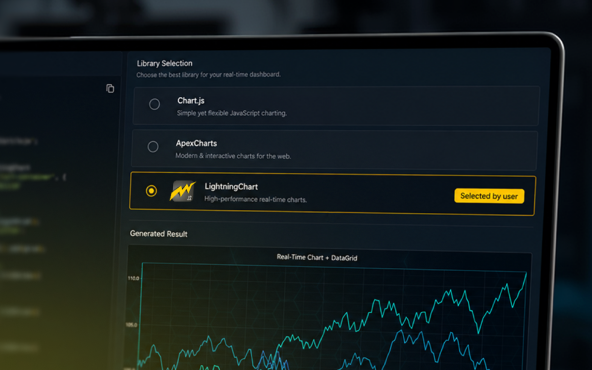
Why AI Coding Agents Get Data Visualization Wrong, and What to Do About It
AI coding assistants are getting good at most parts of application development. Data visualization is one of the areas where they still have a consistent, predictable failure mode. This article explains the mechanics of why it happens and the practical fix. I spent a...
Andrews’ Pitchfork in Technical Analysis
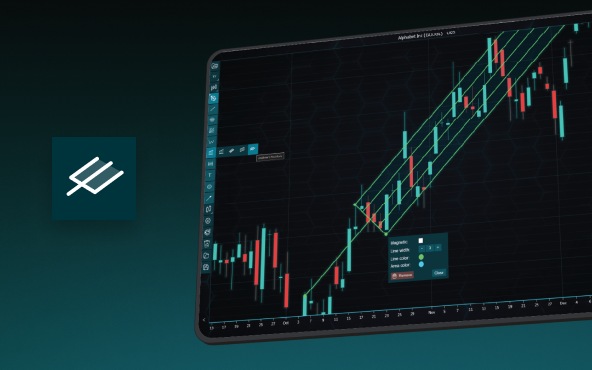
Andrews' Pitchfork is one of the most respected technical analysis tools used by traders to identify potential support and resistance levels, trend direction, and future price paths. Developed by Dr. Alan H. Andrews, the indicator is based on the principle that prices...



If you have any questions, feel free to contact us!



©LightningChart Ltd 2026. All rights reserved.