







Using Fibonacci Tools in Trading: A Practical Guide for Market Analysis
Technical traders rely on various tools to identify potential support, resistance, and price targets. Among the most widely used are Fibonacci tools, which are based on the mathematical sequence discovered by Leonardo Fibonacci in the 13th century. While the Fibonacci sequence has applications in nature, science, and finance, traders primarily use Fibonacci-based indicators to anticipate market retracements, extensions, and reversal zones.
This article explores the most common Fibonacci tools, how they work, and how traders can incorporate them into a comprehensive trading strategy using LightningChart JS Trader.
Fibonacci Sequence and Ratio
The Fibonacci sequence is a mathematical pattern where each number is the sum of the two preceding ones. It begins as follows:
0, 1, 1, 2, 3, 5, 8, 13, 21, 34, 55, 89…
As the sequence progresses, specific ratios emerge that are frequently observed in financial markets:
– 23.6% – for example 21 / 89
– 38.2% – i.e. 34 / 89
– 50.0% – not technically a Fibonacci ratio but commonly used
– 61.8% – the “Golden Ratio”, i.e. 55 / 89
– 78.6% – square root of the Golden Ratio
– 100% – full height (swing high)
– 161.8% – i.e. 89 / 55
– 261.8% – i.e. 89 / 34
These percentages form the foundation of Fibonacci trading tools.
Fibonacci Retracement
Fibonacci Retracement is one of the most popular Fibonacci tools. It helps traders identify potential support and resistance levels during a market pullback.
To draw a retracement:
– In an uptrend, draw from the swing low to the swing high.
– In a downtrend, draw from the swing high to the swing low.
The tool automatically generates retracement levels at key Fibonacci percentages.
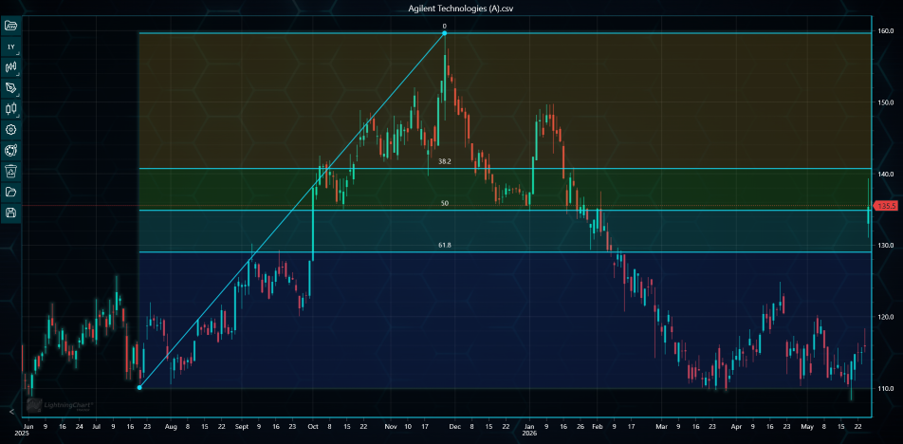
Fibonacci Retracements in LightningChart JS Trader
Suppose a stock rises from $100 to $150. A retracement analysis would identify possible pullback zones:
– 38.2% retracement: $130.90
– 50.0% retracement: $125.00
– 61.8% retracement: $119.10
Many traders look for buying opportunities near the 38.2%, 50%, or 61.8% levels if the overall trend remains bullish.
Tips using Fibonacci Retracements:
– Combine retracement levels with trendlines.
– Look for confirmation using candlestick patterns.
– Use volume analysis to validate support or resistance zones.
Fibonacci Extension
While retracement levels estimate pullbacks, Fibonacci Extensions project future price targets beyond the current trend, often using extension levels (levels of 100% and higher).
Typical Fibonacci Extension is based on three points:
– The starting point of a significant price move (swing low or swing high)
– The end point of that price move
– The end point of the pullback against the price move
Fibonacci levels are then calculated based on the ratio between the first and the second point and plotted from the third point. Various extension levels may include 100%, 127.2%, 161.8%, and 261.8%.
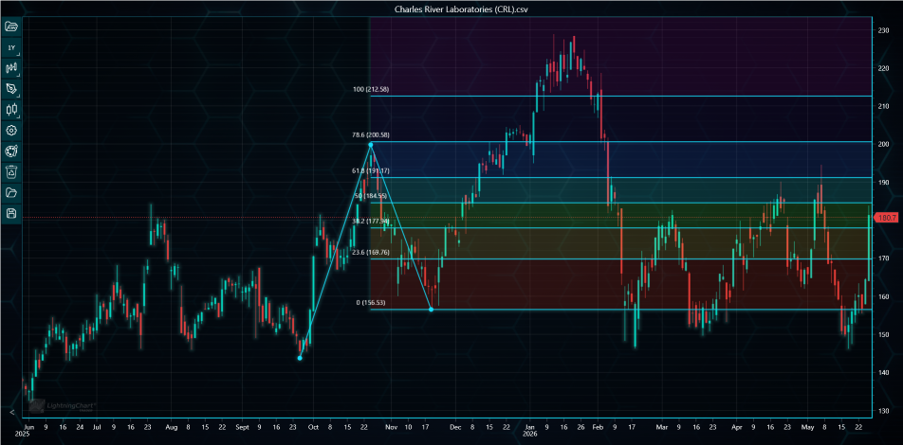
Fibonacci Extensions in LightningChart JS Trader.
Trader entering a long position after a retracement may use Fibonacci extensions to determine profit targets.
For example:
– Initial move: $100 to $150
– Pullback to $125
Results in extension targets:
– 127.2%: approximately $163.60
– 161.8%: approximately $180.90
Extensions help traders establish objective exit points rather than relying solely on intuition.
Fibonacci Fan
Fibonacci Fans consist of diagonal support and resistance lines drawn from a significant swing point. The tool projects trend lines at Fibonacci-based angles that can help identify dynamic support and resistance as well as potential breakout zones.
Fibonacci Fan is drawn based on two points, similarly to Retracements:
– In an uptrend, draw from the swing low to the swing high.
– In a downtrend, draw from the swing high to the swing low.
An “invisible” vertical line is then drawn starting from the end point, followed by three diagonal lines drawn from the start point to intersect the vertical line at the 38.2%, 50%, and 61.8% levels.
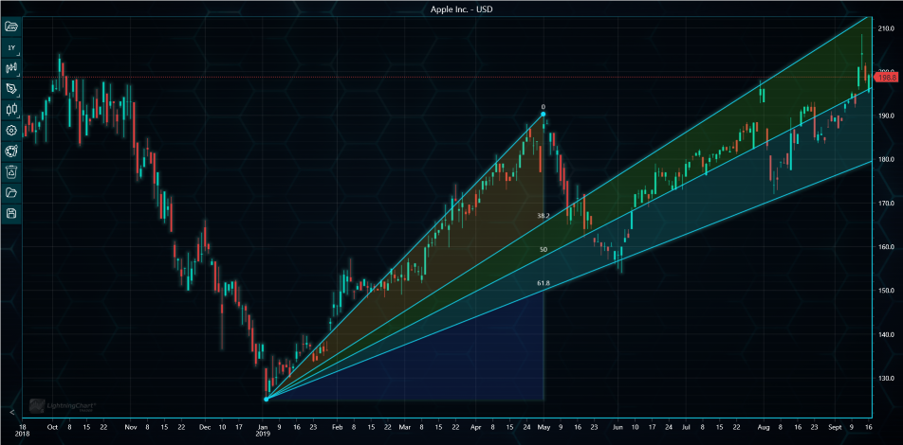
Fibonacci Fan in LightningChart JS Trader
In uptrends, the fan lines below the price signify potential support areas in pullbacks. Likewise in downtrends, the lines above the price work as potential resistance areas during bounces. Fans are particularly useful in strongly trending markets where horizontal support and resistance may provide limited guidance.
Fibonacci Arc
Fibonacci Arcs combine price and time analysis by creating curved support and resistance levels based on Fibonacci ratios. As time progresses, the arcs can indicate potential turning points where price may react. Although less common than retracements and extensions, arcs can provide additional information when analysing long-term trends.
To draw a Fibonacci Arc:
– Draw a line between two points, preferably the start and the end point of a price move.
– Several arcs are then drawn outward from the end point so that their radii are based on the Fibonacci ratios of the original line’s total length.
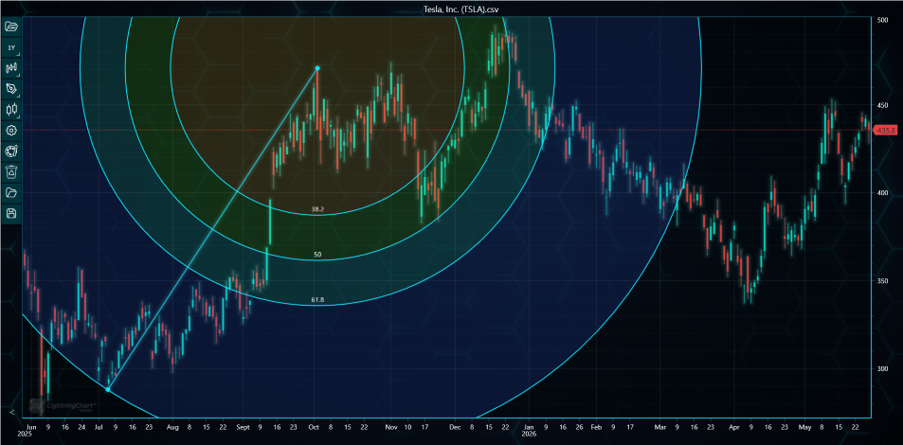
Fibonacci Arc in LightningChart JS Trader
In an uptrend, Fibonacci Arcs indicate potential support zones as the price pulls back. Similarly, in a downtrend, the arcs work as a potential resistance zones when the price bounces.
Fibonacci Time Zones
Unlike most Fibonacci tools, Time Zones focus on timing rather than price. The tool plots vertical lines at Fibonacci intervals of 1, 2, 3, 5, 8, 13, 21, and so on.
Like most Fibonacci tools, Time Zones are based on two points, usually the starting and ending point of a price move. The time difference between these points determines the base interval, which in turn is used to detect the vertical line positions. For example, if the two points are at positions 0 and 1, a vertical line (Time Zone) is plotted at position 0, 1, 2, 3, 5, 8, 13 etc. Likewise, if the points are at 0 and 2, the lines are drawn at 0, 2, 4, 6, 10, 16, 26 etc.
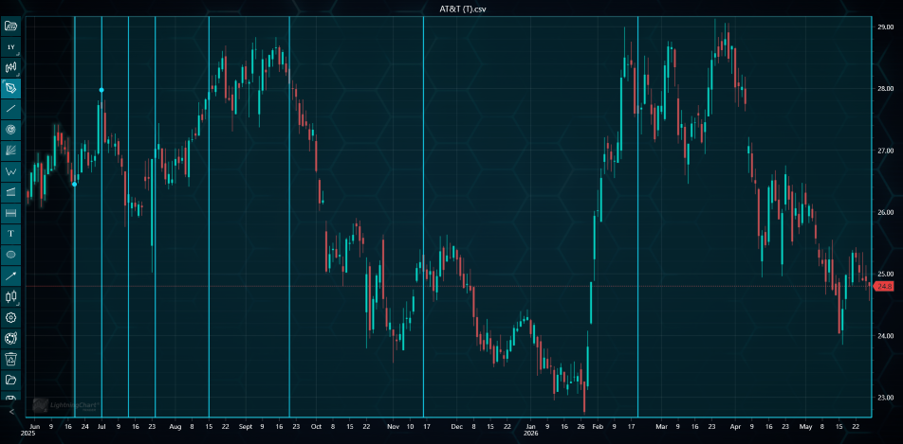
Fibonacci Time Zones in LightningChart JS Trader
Fibonacci Time Zones may highlight periods where either increased volatility occurs, trends accelerate, or reversals become more likely. The zones highlight specific trading times where the market is statistically likely to change.
Fibonacci Time Zones are often used alongside traditional chart analysis rather than as standalone indicators.
Building a Fibonacci Trading Strategy
Traders rarely rely on Fibonacci tools alone. Instead, they combine them with other forms of technical analysis. Here is a simple example of a Fibonacci based trading strategy:
Step 1: Identify the Trend
Use moving averages or market structure to determine whether the market is trending upward or downward.
Step 2: Draw Fibonacci Retracement
Identify the most recent significant swing high and swing low.
Step 3: Watch Key Levels
Pay close attention especially to 38.2%, 50.0%, and 61.8% as these areas often attract buyers or sellers.
Step 4: Seek Confirmation
Look for example bullish or bearish candlestick patterns, momentum divergence (price moves in the opposite direction of a momentum indicator such as RSI or MACD), volume spikes, and support and resistance confluence.
Step 5: Set Targets
Use Fibonacci extensions to define realistic profit zones.
Step 6: Manage Risk
Place stop-loss orders beyond the invalidation point rather than directly on Fibonacci levels.
Pros and Cons of Fibonacci Tools
As with all technical indicators, Fibonacci tools have their advantages and disadvantages.
Pros
- Fibonacci tools provide predefined levels rather than subjective estimates.
- Because many traders monitor Fibonacci levels, they can become self-fulfilling areas of market reaction.
- Fibonacci analysis is versatile and can be applied to stocks, Forex, commodities, cryptocurrencies and futures markets
- Fibonacci tools work across many timeframes including intraday charts, swing trading setups, and long-term investing analysis
Cons
- Markets often ignore certain Fibonacci levels completely. Therefore, only some levels may matter.
- Drawing Fibonacci tools from insignificant swing points can produce misleading results.
- Entering trades solely because price reaches a Fibonacci level can lead to poor outcomes. Therefore, using other indicators as confirmation is strongly adviced.
- Fibonacci tools identify potential reaction zones, not certainties.
Conclusion
Fibonacci tools are among the most versatile and widely used instruments in technical analysis. Retracements help identify pullback opportunities, extensions assist with profit targets, and advanced tools such as fans, arcs, and time zones provide additional market insights.
However, Fibonacci analysis works best when combined with broader market context, risk management, and confirmation from other technical indicators. Rather than treating Fibonacci levels as precise predictions, traders should view them as areas of increased probability where meaningful market reactions may occur.
When used correctly, Fibonacci tools can become a valuable component of a disciplined and systematic trading approach. Start your Fibonacci trading journey today by downloading a free trial at https://lightningchart.com/js-charts/trader/
To learn more about this release, visit the documentation.
See more Blogs
LightningChart .NET v.12.6.1
LightningChart .NET v.12.6.1 is out now!Features of LightningChart® .NET version 12.6.1In this release we added new features, made several improvements and fixed dozens of errors. We upgraded target framework (from .NET 8.0 to 10.0), added Universal-Data-Parser...
Trend Lines in Trading
Trend lines are among the simplest yet most powerful tools in technical analysis. They help traders visualize market direction, identify potential support and resistance levels, and make more informed trading decisions. Despite their simplicity, trend lines remain a...
Announcement: Baumer as LightningChart customer
Enabling High-Performance Visualization of Industrial Sensor Data with LightningChartDiscover how Baumer uses LightningChart to configure and visualize data from a wide variety of industrial sensors and create responsive, data-rich visualization...
Best Python Charting Library in 2026
Python's charting ecosystem is large, overlapping, and regularly misunderstood. Most comparison guides stop at Matplotlib, Plotly, and Seaborn. This one goes further: it covers what happens when your datasets grow large, your update rates increase, or your chart types...



If you have any questions, feel free to contact us!



©LightningChart Ltd 2026. All rights reserved.