








Air-Gapped Environments for Software Development
Article
Written by a Human
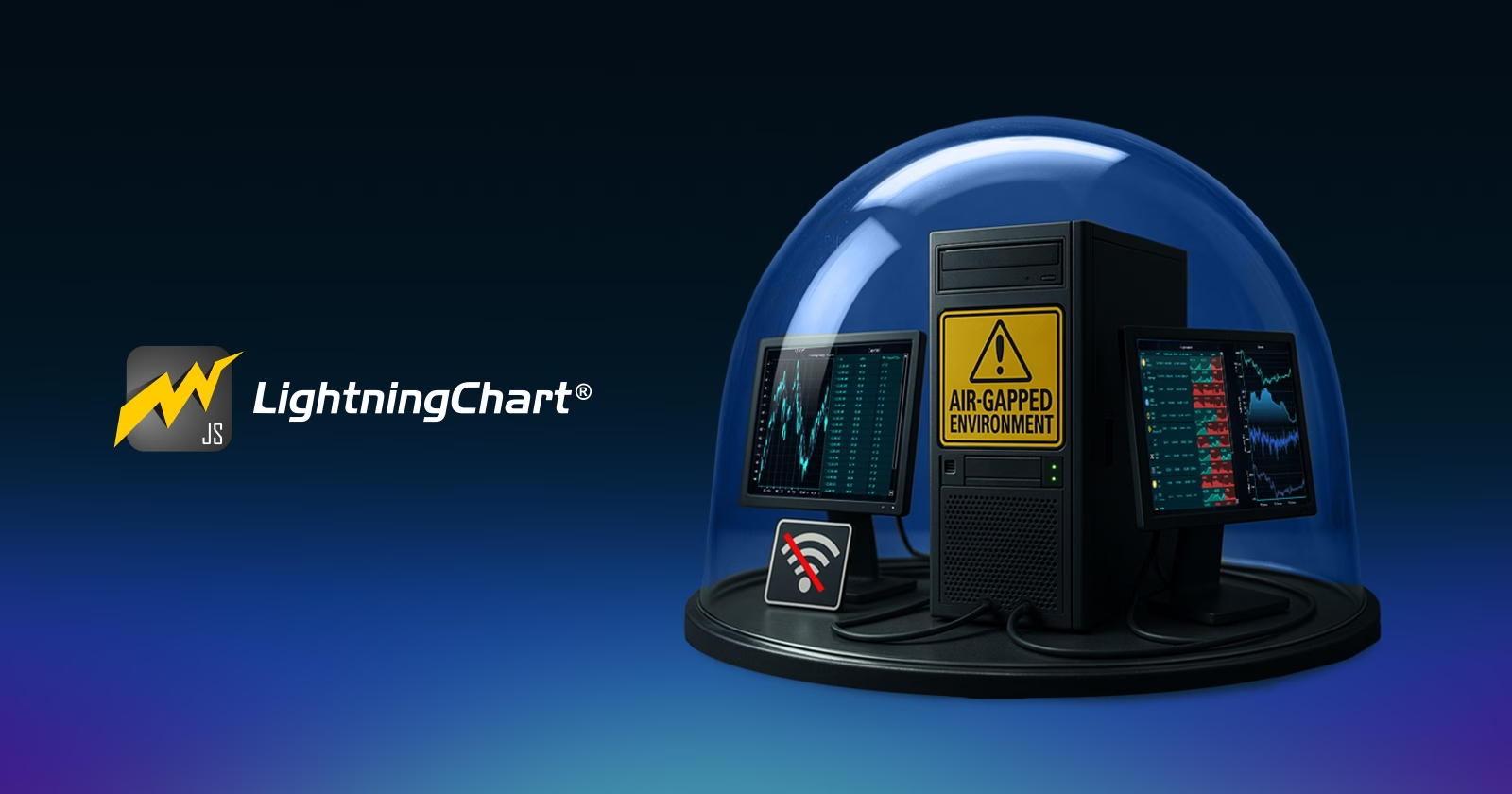
LightningChart JS supports development and deployment within air-gapped environments for critical data protection.
Omar Urbano
Software Engineer

Introduction
In this article, I will explore a key topic for developers and organizations that work under high security standards which is the development in Air-Gapped Environments. In sectors such as aerospace, defense, or scientific research, it is common for systems to operate without an internet connection to protect sensitive data.
However, this restriction often complicates the use of many modern development and visualization tools, which rely on online validation or external services. In previous articles about LightningChart JS, we have demonstrated how to build projects that run perfectly without an internet connection, unless they need to load a specific file from a remote server.
In this context, LightningChart JS provides a strong solution to this challenge by allowing both development and deployment completely offline. This makes it an ideal choice for projects that require total isolation or that operate within secure intranet networks.
What is an Air-Gapped Environment?

An air gap environment is a system or network completely isolated from the public internet and any other external network. Its main purpose is to protect critical or sensitive information from cyberattacks, data leaks, or unauthorized access. Air gap environments are primarily used in industries where security and confidentiality are top priorities, such as:
- Aerospace and defense
- Scientific and medical research
- Critical infrastructure (energy, transportation, communications)
- Banking, government, and military operations
In an air-gapped environment, developers work without internet access, which means that all tools, dependencies, and licenses must operate self-sufficiently within the local network. This is a major challenge for modern applications, as many rely on cloud services, online license verification, or automatic package downloads.
For this reason, technological solutions, such as LightningChart JS, that can operate completely offline represent a significant advantage in these environments, ensuring security, operational continuity, and regulatory compliance, all without sacrificing performance or functionality.
Technical aspects of Air-Gapped environments
From a technical perspective, an air-gapped environment is an infrastructure where no network routes exist to the internet or any external services. This means that every component within the environment (from servers to development workstations) must operate completely autonomously, with full control over dependencies, licenses, and updates.
In practical terms, this means that:
- Access to CDNs for downloading libraries or resources during runtime is not allowed.
- Online license verification and communication with external servers are prohibited.
- Build and run-time environments must rely on local repositories (e.g., offline npm mirrors or private artifact registries).
- Component and library validation must occur offline, through digital signatures or local license files.
This creates specific challenges when working with advanced frameworks or graphical libraries, as many of them depend on cloud-hosted resources or an active connection to validate software usage.
In the case of data visualization solutions and charting libraries like LightningChart JS, this becomes especially important, since high-performance dashboards are expected to function under restricted or fully isolated network conditions (as seen in industrial monitoring systems, aeronautical simulators, or military applications).
Therefore, having a charting library that can render, license, and update itself without relying on an external server is a critical technical requirement in these environments.
How LightningChart JS supports Air-Gapped environments
LightningChart JS was designed with an architecture that does not rely on external resources at runtime, making it ideal for deployment in isolated or high-security environments. Below is an overview of how it addresses the main technical requirements of these scenarios:
Fully Offline Licensing
Unlike many commercial libraries that require license validation through a remote server, LightningChart JS allows licenses to be activated and used without an internet connection.
- The license is validated using a local file or key provided to the user.
- No communication occurs with licensing servers or external endpoints.
- This ensures compliance with strict security policies in environments where external communications are intentionally blocked (e.g., defense, laboratories, SCADA systems, etc.).
Local and Controlled Distribution
LightningChart JS packages can be hosted internally within a private NPM repository or local artifact storage, eliminating the need to download anything from the public network.
- Enables fully internal CI/CD pipelines.
- Installation is performed from a controlled source, ensuring software integrity and traceability.
- Environment maintenance (versions, dependencies, updates) is managed without breaking network isolation.
GPU-Accelerated Rendering with No External Dependencies
The LightningChart JS rendering engine is based on native WebGL and does not require any external libraries, cloud services, or third-party frameworks.
- All rendering is executed locally on the device’s GPU.
- There is no dependency on web APIs, CDNs, or remotely hosted assets.
- This ensures real-time visualization performance even in intranet-only or fully offline environments.
Intranet Network Compatibility
In many air-gapped setups, communication between systems is allowed within the same secure local network. LightningChart JS integrates seamlessly into such configurations:
- Dashboards can connect to internal data sources such as local REST APIs, private databases, or internal OPC-UA services.
- No public certificates or external HTTPS endpoints are required.
- This allows for telemetry, monitoring, or analytics solutions to be implemented without violating isolation policies.
Use Cases in Isolated Environments

Support for air-gapped environments is not just a technical feature but an operational need in sectors where data security and integrity are critical. Some examples include:
- Aerospace and Defense: Flight analysis systems, mission control, or sensor monitoring often run on classified networks without internet access. LightningChart JS enables real-time visualization of large volumes of data (such as telemetry or radar) directly within the internal infrastructure, without exposing sensitive information.
- Research and Laboratories: In scientific projects that analyze confidential experimental data, teams must work completely offline. LightningChart JS provides visual analysis tools and interactive dashboards that operate entirely within the local environment, without external dependencies.
- Critical Industry and Manufacturing: In industrial control systems (ICS/SCADA), networks are isolated for security reasons. LightningChart JS allows integration of advanced dashboards within those systems, leveraging GPU acceleration to display production, vibration, or temperature data without compromising network integrity.
- Custom Engineering Applications: Companies developing internal diagnostic or analysis tools can distribute their software in environments without internet access, since LightningChart JS can be installed, licensed, and executed entirely offline.
Risks of relying on non-isolated environments
In many industrial and defense environments, external connectivity represents an operational and security risk. Other JS charting solutions require constant communication with licensing servers or online validation, introducing critical vulnerabilities in infrastructures where confidentiality and availability are top priorities.
Risks of Mandatory Connectivity
A system that needs to verify licenses over the internet depends on network stability and the availability of the remote server. In restricted or classified networks, this communication is prohibited, which can block application deployment or interrupt its operation at critical moments.
Data Exposure and Traceability
Every attempt to connect to an external server generates network traces and data packets, which in certain environments may violate security or confidentiality policies. This is especially sensitive in military facilities, research laboratories, or SCADA systems, where even encrypted traffic can be considered a threat.
Vendor Dependency
The requirement for online validation introduces a structural dependency: if the provider’s service fails, changes domain, or is discontinued, the developed applications could become unusable. This limits customer autonomy and complicates long-term maintenance.
Technical advantage of LightningChart JS
Unlike other JS charting libraries, LightningChart JS can offer licensing options that are fully operational without an internet connection, both during development and in the final deployment. This ensures that projects can run in completely isolated (air-gapped) networks without relying on validation servers or requiring any connectivity.
Additionally:
- It enables offline development environments, ideal for institutions with strict security policies.
- It ensures operational continuity in critical systems without the risk of interruptions due to external validations.
- It complies with industrial and governmental security standards that require complete independence from online services.
While other JS libraries depend on connectivity to function and verify licenses, LightningChart JS is designed to maintain its performance, security, and full autonomy even under the most restricted conditions.
Conclusion
In a world where digital security and technological independence are decisive factors in data-intensive industries, the ability to operate in completely isolated environments is not only optional but has become an essential requirement in modern development.
LightningChart JS stands out as a robust, secure, and self-sufficient tool, capable of delivering high-performance visualizations without relying on external validations or an internet connection. Its architecture is designed for sensitive and critical environments, where operational continuity and data protection are top priorities.
In contrast, other charting solutions that require constant connectivity compromise autonomy, stability, and compliance with security policies in industries where every bite of information must remain within the local perimeter.
With LightningChart JS, development teams can create advanced dashboards, interactive visualizations, and real-time analytics systems that are fully functional in air-gapped networks, ensuring both technical efficiency and the operational reliability demanded by modern engineering.
Continue learning with LightningChart

how to create audio output signal reader
Written by a human | Updated on April 10th, 2025What is an Audio Output Signal Reader? An audio output signal reader is a device or software that reads and processes the audio output signal from an audio source and outputs it in a readable or usable format, such...
Audio Input Spectrogram Chart
Written by a human | Updated on April 10th, 2025Audio Input Spectrogram Chart LightningChart .NET is a powerful data visualization tool that provides advanced charting capabilities for the .NET framework. One of its key features is the spectrogram chart, which...

EEG Chart
Written by a human | Updated on April 10th, 2025EEG Chart The human brain is one of the most complex and fascinating structures in the world. Scientists have been studying the brain for years to better understand how it works and to find ways to diagnose and...



If you have any questions, feel free to contact us!
©LightningChart Ltd 2025. All rights reserved.