






Complete Guide to Volume Weighted Moving Average
Article
A technical implementation guide of Volume Weighted Moving Average Indicator using LightningChart JS Trader for developing Fintech applications.
Ahmad Omid
Data Science Developer


What is Volume Weighted Moving Average?
The Volume Weighted Moving Average (VWMA) is a crucial technical indicator widely used in trading and financial analysis. Unlike traditional moving averages, which calculate the average price over a specific period without considering the trading volume, the VWMA incorporates volume into the calculation, allowing traders to get a more comprehensive view of market trends and price movements. In other words, the Volume Weighted Moving Average (VWMA) takes volume into account when weighting prices during moving average calculations. It highlights points where high-volume trading influences the price significantly, helping traders make informed decisions based on both price and volume data.
Importance of VWMA in Trading and Technical Analysis
VWMA plays a vital role in identifying trends and potential reversal points, especially in markets where volume fluctuation impacts price movement. By factoring in volume, VWMA can filter out “noise” in low-volume periods and highlight substantial price changes during high-volume trading. This feature makes VWMA an essential tool for day traders, swing traders, and investors who rely on volume analysis to gain insights into market momentum.
What is Elastic Volume Weighted Moving Average?
The Elastic Volume Weighted Moving Average (EVWMA) is a refined version of the VWMA that adapts to changes in trading volume dynamically. Unlike the standard VWMA, which calculates based on a fixed period, EVWMA adjusts itself according to the volume fluctuations within the market. This “elastic” quality allows it to be more responsive to sudden changes in trading volume, making it more adaptive to real-time market conditions.
How EVWMA Adapts to Market Changes
The EVWMA dynamically increases its weighting during high-volume periods and reduces it during low-volume periods, creating a more sensitive and flexible moving average. This flexibility can help traders capture trends in fast-paced markets or detect early signs of reversals by responding quickly to volume changes. As a result, EVWMA is particularly useful for day trading and short-term strategies, where the timing of entries and exits is critical.
Volume Weighted Moving Average Formula
How to calculate VWMA
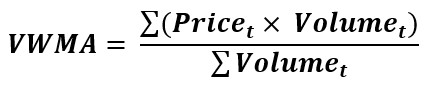
The VWMA calculation assigns weights to each price based on the volume for each time period, which increases the influence of high-volume price data in the average. Here’s how to calculate VWMA:
- Multiply each price by its corresponding volume over the defined period.
- Sum the resulting values.
- Divide by the total volume for the period.
Practical Examples Using VWMA Formula
For instance, in a 5-period VWMA calculation: Assume the price and volume data for five periods as follows:
Step 1: Calculate the Product of Price and Volume
Multiply each period’s price by its corresponding volume.
- Period 1: 100 × 500 = 50,000
- Period 2: 102 × 700 = 71,400
- Period 3: 101 × 800 = 80,800
- Period 4: 103 × 600 = 61,800
- Period 5: 104 × 900 = 93,600
Then, add up all the values to get the total price-volume product:
50,000 + 71,400 + 80,800 + 61,800 + 93,600 = 357,600
Add up all the volumes:
500 + 700 + 800 + 600 + 900 = 3,500
Step 2: Divide the Total Price-Volume Product by the Total Volume
Finally, calculate the VWMA by dividing the total price-volume product by the total volume:
VWMA = 357,600 / 3,500 = 102.17
This result reflects a volume-weighted average price where higher-volume periods have a more significant influence on the average.
Understanding VWAP (Volume Weighted Average Price)
What is VWAP and How Does It Differ from VWMA?
The Volume Weighted Average Price (VWAP) is another popular volume-based indicator, but it serves a slightly different purpose than VWMA. While VWMA averages the closing prices of each period based on volume, VWAP calculates the weighted average price for the entire day, resetting at the beginning of each trading session. It’s often used by institutional traders and large investors to measure intraday performance and determine if they are buying below or selling above the average price.
VWAP meaning and calculation
VWAP provides a benchmark for traders and institutional investors to determine the day’s average price, reflecting both price and volume. It’s particularly useful because it allows traders to gauge the asset’s market sentiment, whether buyers or sellers dominate.
The VWAP calculation is refreshed with each new trade and uses cumulative values for price and volume. Here’s a step-by-step outline of the formula and process:

This formula captures the volume-weighted average for the trading day, resetting at the start of each new trading session.
How to Create the Technical Indicator Using LC JS Trader
Step 1: Get LightningChart JS Trader
To begin, you’ll need access to LightningChart JS Trader. This library provides the tools necessary to create advanced technical indicators, including the Volume Weighted Moving Average (VWMA) indicator. Visit the LightningChart JS Trader page to download the required components and review the documentation.
Step 2: Review the Interactive Example
LightningChart JS Trader includes interactive examples that demonstrate how to create custom technical indicators. Start by reviewing the documentation, focusing on how to integrate the Volume Weighted Moving Average (VWMA) into your chart setup. The interactive examples will guide you through the process of setting up the VWMA, from importing the necessary modules to modify the chart settings.
Step 3: Code Explanation
In this step, we will break down the code that creates the chart with the Volume Weighted Moving Average (VWMA) indicator, as shown in the image, using LightningChart JS Trader. The code demonstrates how to initialize a trading chart, apply the VWMA indicator, and customize its appearance.

Here’s a detailed breakdown of each section:
A. Importing the Required Libraries:
   const lcjsTrader = require('@arction/lcjs-trader')
   const lcjs = require('@arction/lcjs')
const { Themes } = lcjs- lcjsTrader: This library provides access to the LightningChart JS Trader functionalities, allowing you to create advanced financial charts.
- lcjs: The main LightningChart JS library, used for general charting functionality.
- Themes: A property within lcjs that provides access to pre-built themes. In this case, we are using the darkGold theme to style the chart.
B. Initializing the Trading Chart:
   lcjsTrader.trader(TRADER_LICENSE).then(async (trader) => {
    // Create a trading chart.
const tradingChart = trader.tradingChart({ loadFromStorage: false, colorTheme: Themes.darkGold })trader(TRADER_LICENSE): Initializes the LightningChart JS Trader with the provided license key (TRADER_LICENSE). This is required to access the charting functionalities for financial data.
Note you can request a LightningChart JS Trader trial license, which is free.
tradingChart(): This function creates a trading chart with certain options.loadFromStorage: false: This disables the loading of previously stored chart data from local storage, ensuring a fresh chart setup.colorTheme: Themes.darkGold: This applies the darkGold theme to the chart, which influences the background color, gridlines, and other visual elements.
C. Adding and Customizing the Indicator
    // Add a Volume Weighted Moving Average Indicator
    const vwma20 = tradingChart.indicators().addVolumeWeightedMovingAverage()
    vwma20.setPeriodCount(20)
    vwma20.setLineColor('#3B67BF')
vwma20.setLineWidth(3)addVolumeWeightedMovingAverage(): VWMA takes volume into account when weighting prices during moving average calculations.
setPeriodCount(20): Sets the time period for the VWMA to 20. This means the VWMA will calculate the average based on the last 20 data points.
setLineColor('#3B67BF'): Changes the color of the VWMA line to shade of blue, making it visually distinct on the chart.
vwma20.setLineWidth(3): Increases the line thickness of the VWMA to 3 pixels, making the line more prominent on the chart.
D. Loading Data from a CSV File
    // Reading data from a file.
    await fetch(`${document.head.baseURI}examples/assets/0000/Alphabet Inc (GOOGL).csv`).then((res) => res.text()).then((text) => {
        tradingChart.readCsvString(text, 'Alphabet Inc (GOOGL)')
})fetch(): This function retrieves a CSV file containing historical data for Alphabet Inc. (GOOGL). The CSV file includes pricing information for the company’s stock, which is plotted on the chart.readCsvString(): This function reads the CSV data and interprets it as pricing data for Alphabet Inc. The second argument (‘Alphabet Inc (GOOGL)’) sets the label for the chart, as seen at the top of the chart image.
E. Setting the Currency for the Chart
    tradingChart.setCurrency('USD')
})setCurrency('USD'): This sets the currency of the chart to USD, ensuring that the pricing data is interpreted and displayed in US dollars.
Advantages and Limitations of the Indicator
The Volume Weighted Moving Average (VWMA) offers some valuable advantages for traders, especially in markets where volume significantly impacts price movement. By incorporating trading volume into the average, VWMA provides a more responsive view of the price trend, allowing traders to identify strong trends when high trading volumes align with price changes.
This focus on volume helps to reduce “noise,” filtering out minor price fluctuations that occur during low-volume periods and highlighting price points that truly matter, particularly in high-volume trading. However, VWMA has its limitations. Like all moving averages, VWMA is a lagging indicator that relies on historical data, which means it may be slow to react to sudden reversals.
This lag makes it harder for traders to capture quick shifts in price, which can be critical in fast-moving markets. VWMA also works best in assets or markets with consistent, predictable volume. In markets with erratic volume patterns, VWMA may produce less reliable signals, as unexpected spikes or drops in volume can affect its accuracy.
For low-volume assets, VWMA may also lose its effectiveness, as there may not be enough volume data to make the weighting impactful, making other moving averages like the simple or exponential moving average potentially more suitable.
In summary, VWMA is highly beneficial for traders looking to factor volume into their trend analysis, but it’s most effective in stable-volume environments and can be less responsive in volatile markets.
Conclusion
The Volume Weighted Moving Average (VWMA) is a valuable tool for traders seeking to incorporate volume sensitivity into their analysis. By accounting for trading volume, VWMA offers a nuanced understanding of price trends and potential reversal points, especially when used alongside other indicators. The Elastic Volume Weighted Moving Average (EVWMA) further enhances this by adapting to real-time volume changes, making it suitable for fast-paced markets.
For traders working with these indicators, LightningChart JS Trader is an essential platform that allows for the precise calculation and visualization of VWMA and other indicators in a highly interactive environment.
This tool’s flexibility and speed enable traders to experiment with volume-based indicators like VWMA, helping them refine strategies in real-time. The ease of customization within LightningChart JS Trader also supports traders in applying these indicators effectively to their unique trading styles.
Continue learning with LightningChart
Javascript Charting Library comparison 2026
Every year someone publishes a listicle of JavaScript charting libraries. They screenshot a demo, note the GitHub stars, paste in the npm install command, and call it a day. Then you follow their recommendation, get six months into your project, and discover that your...
Visualizing 10 Million Data Points in the Browser (2026): The Technical Deep-Dive
Ten Million Data Points in the Browser: How WebGL Makes Mass Datasets Interactive Ten million data points. That number used to mean a database problem, not a front-end problem. Now research teams want to explore it interactively in a browser. Trading desks want...
Elliott Wave Theory in Trading
Financial markets often appear chaotic, but many traders believe that price movements follow recurring patterns driven by human psychology. One of the most influential approaches based on this idea is the Elliott Wave Theory. Developed nearly a century ago, it remains one of the most widely studied methods of technical analysis.



If you have any questions, feel free to contact us!



©LightningChart Ltd 2026. All rights reserved.