







LightningChart JS TraderFractal Chaos Bands Indicator
ArticleLearn more about the theory and practical implementation behind the Fractal Chaos Bands Indicators.
Written by a human | Updated on April 24th, 2025
Introduction to Fractal Chaos Bands Indicators
In the fast-paced world of financial markets, technical indicators are indispensable tools that help traders make informed decisions. One such tool is the Fractal Chaos Bands Indicator, a concept deeply rooted in the principles of chaos theory and fractal geometry. This indicator, while lesser-known than traditional tools like moving averages or the RSI, provides critical insights into price behaviour by using fractals in trading.
This article will provide a detailed overview of the Fractal Chaos Bands Indicator, its background, application in modern trading systems, and a practical guide on how to implement it using LightningChart JS Trader. We will also delve into the concept of fractal trading and explore how fractals in forex trading and other financial markets offer a unique perspective on price fluctuations.
What is the Fractal Chaos Bands Indicator?
The Fractal Chaos Bands Indicator is a technical analysis tool that combines elements of fractal trading and chaos theory. The indicator forms two bands around the price movement, and these bands adjust dynamically based on the fractal structure of the market.
The primary objective of the fractal chaos band is to capture the inherent fractal nature of market prices, which tend to exhibit patterns within patterns, a hallmark of chaos theory. By doing so, the indicator attempts to identify potential reversal points and breakout opportunities in a trend.
Importance in Technical Analysis
While not as widely adopted as more conventional indicators, the Fractal Chaos Bands Indicator offers significant value, particularly in markets where volatility and unpredictable price swings are the norm. Traders who employ fractal trading techniques use it to gain an edge by identifying fractal structures that traditional indicators may overlook.
Moreover, this indicator has gained traction in algorithmic trading systems and quantitative analysis models where fractal mathematics plays a key role in understanding the chaotic nature of markets.
Understanding Fractal Chaos Bands Indicator
What is Fractal Trading?
Fractal trading is a strategy that revolves around the idea that price patterns repeat across different timeframes in a seemingly chaotic manner. Fractals, in the context of trading, are specific price patterns that indicate potential turning points in the market. These patterns often consist of five or more bars and occur frequently, providing traders with ample opportunities to capitalize on price movements.
How Are Fractals Identified in Price Charts?
Fractals are identified by looking at five or more consecutive price bars and identifying the highest high or lowest low, surrounded by lower highs or higher lows on either side. These patterns reveal potential market turning points and form the basis of trading fractals strategies.
In the context of the Fractal Chaos Bands Indicator, these fractals are used to adjust the upper and lower bands dynamically, thus creating a trading range that adapts to the underlying fractal structure of the market.
Chaos Trading Systems and Fractals
Chaos theory postulates that markets exhibit seemingly random behavior, yet underneath this randomness, there is an underlying order that can be detected with the right tools. Fractals trading systems leverage this by identifying recurring patterns within the market’s chaotic movements.
By incorporating fractals in trading, traders can better understand the market’s behavior and use this understanding to anticipate future price movements. Fractal chaos trading systems are built around the idea that fractals offer predictive power when analyzing market trends and reversals.
How to Use the Fractal Chaos Indicator in Trading Systems?
The Fractal Chaos Bands Indicator can be used across different asset classes, including forex, stocks, and cryptocurrencies. It is particularly effective in highly volatile markets where price action is difficult to predict using traditional methods.
Traders often use the fractal chaos bands indicator to:
- Identify trend reversals: When the price touches or breaks through the bands, it can indicate the beginning or end of a trend.
- Trade breakouts: Breakouts outside the bands suggest strong momentum and potential continuation of the trend.
- Spot consolidation zones: When prices remain between the bands for an extended period, it could indicate a consolidation phase before the next significant move.
How to Trade Fractals in Different Markets?
- Forex: In forex trading, fractals help traders understand market cycles and anticipate trend reversals. Fractals in forex trading are commonly used in combination with other indicators, like the Alligator indicator.
- Stocks: For stock trading, a fractals trading strategy is often employed to identify patterns that signify the end of price rallies or pullbacks.
Cryptocurrencies: Due to their volatile nature, cryptocurrencies are an ideal candidate for trading with fractals. The Fractal Chaos Bands Indicator helps to filter out market noise and focus on meaningful price movements.
Fractal Trading Systems and Strategies
What is a fractal in forex trading?
In forex trading, a fractal refers to a specific price pattern that indicates potential turning points in the market. This pattern typically consists of five or more consecutive candlesticks (or price bars), where the central candlestick represents a peak or a trough, and is flanked by two lower highs (in the case of a top fractal) or two higher lows (in the case of a bottom fractal) on either side. These formations represent areas of market indecision that often precede significant price reversals or trend continuations.
Bill Williams Fractal Trading System
The Bill Williams Fractal Trading System is one of the most popular methods for using fractals in technical analysis. Williams believed that the market exhibits fractal structures across different timeframes and that identifying these fractals can provide crucial insights into market dynamics.
Fractal Energy Trading System
The fractal energy trading system builds upon the idea of using fractals to measure the energy or momentum within a market. When fractal patterns suggest increased energy, it often precedes significant price movements.
Forex Fractal Trading System
Fractals in forex trading are used as signals to identify important support and resistance levels. The fractal pattern, when confirmed, can provide traders with entry and exit points, allowing them to capitalize on potential reversals in the market.
Identifying Fractals in Forex
To better understand what constitutes a fractal in forex trading, consider this simplified example of how to identify fractals on a price chart:
- Upward fractal (sell signal): When a price bar is surrounded by two lower highs on either side, this forms an upward fractal. It suggests a potential downward reversal and serves as a sell signal.
- Downward fractal (buy signal): When a price bar is surrounded by two higher lows on either side, it forms a downward fractal. This indicates a potential upward reversal and acts as a buy signal.
These fractal patterns are significant because they represent moments when the market fails to maintain a direction, often leading to reversals. In highly liquid and volatile markets like forex, such patterns can appear frequently, giving traders valuable insights into potential price shifts.
Practical Use of Fractals in Forex Trading
Fractals in forex trading are often used in conjunction with other technical indicators to improve the accuracy of trade signals. For example, traders might combine fractals with moving averages, oscillators like the MACD, or momentum indicators to confirm trends and avoid false signals.
A common strategy is to wait for fractal formations to align with the general direction of the trend. For instance, if the market is in an uptrend, traders might prioritize buy signals generated by downward fractals, as these represent a temporary pullback within the broader trend. Conversely, in a downtrend, upward fractals can be used as confirmation to enter short positions.
The Role of Fractals in Forex Strategies
Fractals play a central role in many forex fractal trading systems, such as the Bill Williams Fractal Trading System, where they serve as foundational tools for analyzing market behaviour. Williams used fractals in his approach to identify market structure and turning points, which are critical for determining the direction of future price movements. The system utilizes fractals in forex trading to establish key support and resistance levels and to help traders ride trends more effectively.
Additionally, traders who adopt a fractal forex trading strategy often set their stop-loss orders around the fractal points, placing them just above a sell fractal or below a buy fractal. This placement helps to manage risk while giving the market room to move without prematurely closing trades due to normal market fluctuations.
In summary, a fractal in forex trading is a technical formation that helps traders identify potential reversals by highlighting key support and resistance levels. Fractals are most effective when combined with other technical indicators and trading systems, as they provide signals that can guide entry and exit points in highly dynamic and liquid markets like forex.
Fractals in forex trading are widely used by traders who appreciate the repetitive nature of price movements and want to leverage this to their advantage. When used correctly, they offer a powerful tool for anticipating market turns and maximizing profitability in forex trading strategies.
Mathematical Formula Behind the Fractal Chaos Bands Indicator
The Fractal Chaos Bands Indicator is based on the principles of fractal geometry and chaos theory. It uses fractals to create dynamic bands that adjust to market volatility and price movements. While the visual representation of the indicator is straightforward—two bands enclosing price action—the underlying mathematical foundation involves calculating fractal patterns and applying these patterns to the price series.
Key Components
The Fractal Chaos Bands Indicator relies on identifying fractal patterns, which are typically composed of five consecutive price bars (or candlesticks). These fractals are used to dynamically adjust the upper and lower bands in the indicator. Here’s how the formula behind the indicator works:
Fractal Identification:
- Upward fractal (local maximum): A peak formed by five bars where the highest high is surrounded by two lower highs on both sides.
- Downward fractal (local minimum): A trough formed by five bars where the lowest low is surrounded by two higher lows on both sides.
- Fractal-Based Bands: The upper and lower bands are calculated based on fractal highs and lows, which are detected within the price series. The bands adapt dynamically as new fractals are identified.
The formula for the Fractal Chaos Bands Indicator can be broken down as follows:
- Upper Band:
UpperBand(t)=Max High of the last N fractals
Where:
- ? represents the current time or price bar.
- ? is the number of fractals used in the calculation (usually a rolling window of the most recent fractals).
- The Max High is the highest price level among the identified upward fractals.
- Lower Band:
LowerBand(t)=Min Low of the last N fractals
Where: The Min Low is the lowest price level among the identified downward fractals.
Calculation Details of a Fractal
To calculate an upward or downward fractal in the price chart, consider a five-bar sequence:
- Upward fractal: If the middle bar of the sequence has the highest height compared to the two bars before and the two bars after it, an upward fractal is identified.
Where: ?0 is the highest high in the middle, and H1, H2, H−1, and H−2 are the highs of the surrounding bars.
- Downward fractal: If the middle bar of the sequence has the lowest low compared to the two bars before and after, a downward fractal is identified.
L0 is the lowest low in the middle, and L1, L2, L−1, and L−2 are the lows of the surrounding bars.
Example of Fractal Chaos Bands Indicator Calculation in Practice:
Let’s break down a practical example of calculating and using the Fractal Chaos Bands Indicator on a hypothetical price chart with 10 data points.
Step 1: Price Data
Here is a simplified set of closing price data for 10 candlesticks:
Step 2: Identifying Fractals
To calculate the fractals, we need to look at the five-bar patterns where the middle bar is the highest or lowest point in relation to the two bars before and after it.
- Upward Fractal (Local Maximum): The middle bar has the highest high compared to the two bars on either side.
- Downward Fractal (Local Minimum): The middle bar has the lowest low compared to the two bars on either side.
Let’s check for fractals in the data:
- Bar 3 (High 105): Compare with Bar 1 and 2 (Highs: 100, 102) and Bar 4 and 5 (Highs: 103, 101). Since Bar 3 has the highest high, it forms an Upward Fractal.
- Bar 9 (Low 91): Compare with Bar 7 and 8 (Lows: 93, 92) and Bar 10 (Low 90). Since Bar 9 is not lower than Bar 10, no fractal is formed here. However, Bar 10 (Low 90) is lower than the surrounding lows (91, 93, 92), so it forms a Downward Fractal.
Step 3: Calculate the Fractal Chaos Bands Indicator
Once we identify the fractals, we use them to create the upper and lower bands.
- Upper Band: This is based on the highest high of the most recent upward fractal.
- The most recent Upward Fractal is at Bar 3 with a high of 105.
- So, the Upper Band will be set to 105 until another upward fractal is identified.
- Lower Band: This is based on the lowest low of the most recent downward fractal.
- The most recent Downward Fractal is at Bar 10 with a low of 90.
- So, the Lower Band will be set to 90.
Step 4: Band Adjustment Based on New Fractals
As new fractals are identified in the price data, the upper and lower bands adjust. For instance:
- If a new Upward Fractal forms at a price higher than 105, the Upper Band will shift up to this new high.
- If a new Downward Fractal forms at a price lower than 90, the Lower Band will adjust downward to reflect this new low.
Step 5: Example Usage in Trading
Traders use these bands to make decisions:
- If the price breaks through the upper band (e.g., a close above 105), this might indicate a bullish breakout and a potential buying opportunity.
- If the price breaks through the lower band (e.g., a close below 90), this could signal a bearish reversal, indicating a potential sell signal.
In this case:
- After Bar 10, if prices start to rise above 105, it may signal a breakout of the Upper Band, suggesting a new upward trend.
- Conversely, if prices fall below 90, this may indicate a downside breakout and potential further decline.
Band Construction and Dynamic Adjustments
Once the fractals have been identified, the upper and lower bands are dynamically adjusted to capture the highest highs and lowest lows of the most recent fractal patterns. This creates a chaos band that expands and contracts depending on market volatility.
- Expanding bands: If volatility increases and the fractals show larger price movements, the upper and lower bands will expand, creating wider bands that reflect the increasing chaos in the market.
- Contracting bands: If volatility decreases and fractal price movements become smaller, the bands will contract, indicating more stability and less price fluctuation.
Band Construction and Dynamic Adjustments
Once the fractals have been identified, the upper and lower bands are dynamically adjusted to capture the highest highs and lowest lows of the most recent fractal patterns. This creates a chaos band that expands and contracts depending on market volatility.
- Expanding bands: If volatility increases and the fractals show larger price movements, the upper and lower bands will expand, creating wider bands that reflect the increasing chaos in the market.
- Contracting bands: If volatility decreases and fractal price movements become smaller, the bands will contract, indicating more stability and less price fluctuation.
Fractal Trading System: Does it really work?
The effectiveness of the Fractal Trading System is a critical question for traders who are looking to adopt this approach. To evaluate whether fractal trading systems really work, we must understand their theoretical basis, practical application, and performance in real-world markets. This deeper reflection will address the complexities and nuances that come with trading using fractals and chaos theory, highlighting the conditions under which this strategy excels and when it might fall short.
Theoretical Strengths of Fractal Trading Systems
At the core of the fractal trading system is the concept that markets exhibit fractal patterns—repeating structures that exist across different timeframes, from seconds to years. This belief is supported by chaos theory, which suggests that within the apparent randomness of markets, there is an underlying order. Fractals in trading attempt to decode this order, giving traders a tool to predict reversals and continuation patterns based on repetitive price formations.
The key strength of the fractal system lies in its adaptability. Since fractal structures are self-similar across different scales, traders can apply fractal trading techniques to any market and timeframe, making the strategy versatile. Whether in forex, stocks, or cryptocurrencies, trading fractals provides a way to identify key turning points in price movement. The ability to spot these patterns early can lead to profitable trades, especially in highly volatile markets where other indicators may struggle to capture the full scope of price dynamics.
Practical Application and Limitations
While the theoretical foundation of fractals in trading is sound, real-world application often reveals several limitations that need to be carefully considered. Fractal trading systems do not work in isolation; they often require complementary tools like moving averages or momentum indicators to filter out false signals. Market noise and low volatility can easily disrupt the effectiveness of fractals, producing misleading signals that lead to unprofitable trades.
One of the most significant challenges in using fractal trading strategies is their reliance on historical data to predict future movements. Although fractal structures repeat, market conditions, influenced by external factors such as news events or shifts in market sentiment, may not always align with the patterns identified by the fractal system. This leads to a key limitation: fractals trading systems can produce many false signals, especially in sideways or low-volatility markets where clear trends are absent.
Conditions for Success in Fractal Trading
For the fractal trading system to truly work, certain market conditions need to be met. First, fractals are most effective in trending markets where price patterns follow predictable fractal formations. In such environments, trading fractal indicators can reliably signal trend reversals or continuations, providing traders with timely entry and exit points.
Moreover, combining fractals with other indicators can enhance their accuracy. For example, traders often use the Bill Williams Fractal Trading System in conjunction with the Alligator indicator, which filters out market noise and confirms the direction of the trend. This multi-layered approach reduces the risk of false signals, improving the overall success rate of the system.
Adaptation and Optimization in Different Markets
The effectiveness of fractals in forex trading, stocks, and cryptocurrencies varies based on the nature of each market. For instance, forex fractal trading systems tend to perform well due to the relatively stable fractal patterns in currency pairs, which are less influenced by single market participants. In contrast, fractals trading in highly speculative or illiquid markets, such as certain stocks or cryptocurrencies, can be more unpredictable because large price moves can disrupt the fractal structures.
Traders who specialize in forex fractal trading or fractal stock trading have found success by optimizing their systems to the specific characteristics of these markets. The key lies in understanding how fractals form under different conditions and adjusting the trading system accordingly. For example, in volatile markets, traders may use wider stop-losses and more conservative take-profit levels to account for erratic price movements.
Does It Really Work?
So, does the fractal trading system really work? The answer is not a simple yes or no—it depends largely on the trader’s expertise, the market conditions, and how the system is integrated into a broader trading strategy. Fractal trading techniques can be highly effective in markets that exhibit clear fractal patterns and trends. However, like any technical tool, fractals are not a silver bullet. They require careful analysis, and proper risk management, and often need to be used in conjunction with other indicators to maximize their effectiveness.
In conclusion, the fractal trading system does work under the right circumstances and for traders who invest the time to understand how to use it effectively. It is not foolproof, and its success largely depends on market conditions, the timeframe being analyzed, and the trader’s skill in combining fractals with other technical indicators. Fractal trading systems offer a unique lens through which to view market movements, but like any system, they must be used with caution and adaptability.
The Role of LightningChart JS Trader in Financial Analysis

Financial analysis involves examining historical data to forecast future trends, make informed decisions, and assess risk. In this domain, applications like LightningChart JS Trader serve a critical role by providing real-time, high-performance data visualization tools that help traders and analysts better interpret complex datasets. It enables traders to track market trends using built-in indicators.
The platform’s ability to handle large datasets and real-time updates makes it essential for fast decision-making in dynamic markets. Additionally, its customization options allow users to create tailored charts and apply statistical indicators, enhancing both the precision of analysis and risk management. This tool helps streamline financial analysis and supports more informed, data-driven trading strategies.
How to Create the Fractal Chaos Bands Indicator Using LightningChart JS Trader
Advanced charting platforms like LightningChart JS offer traders a range of technical indicators, including the Fractal Chaos Bands indicator. LightningChart JS allows traders to create interactive, high-performance charts, ensuring real-time data visualization. This platform is particularly useful for traders who rely on technical indicators such as the Fractal Chaos Bands indicator to make quick, informed decisions.
Step 1: Get LightningChart JS Trader
To begin, you’ll need access to LightningChart JS Trader. This library provides the tools necessary to create advanced technical indicators, including the Fractal Chaos Bands indicator. Visit the LightningChart JS Trader page to download the required components and to review the documentation.
Step 2: Review the Interactive Example
LightningChart JS Trader includes interactive examples that demonstrate how to create custom technical indicators. Start by reviewing the documentation, focusing on how to integrate Fractal Chaos Bands indicator into your chart setup. The interactive examples will guide you through the process of setting up the Fractal Chaos Bands indicator, from importing the necessary modules to modify the chart settings.
Step 3: Code Explanation
In this step, we will break down the code that creates the chart with the Fractal Chaos Bands indicator, as shown in the image, using LightningChart JS Trader. The code demonstrates how to initialize a trading chart, apply the Fractal Chaos Bands indicator, and customize its appearance.
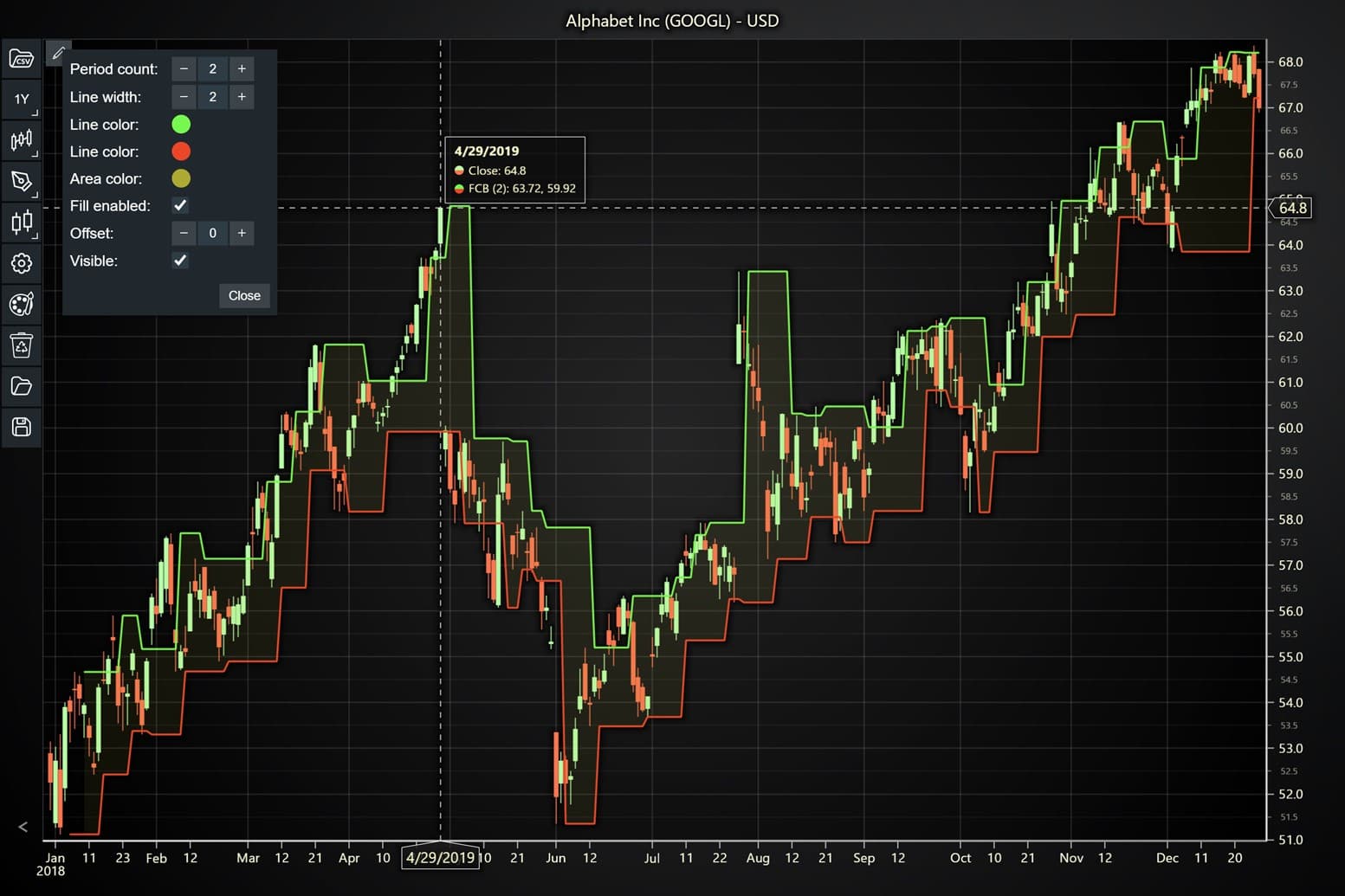
Here’s a detailed breakdown of each section:
A. Importing the Required Libraries:
   const lcjsTrader = require('@arction/lcjs-trader')
   const lcjs = require('@arction/lcjs')
const { Themes } = lcjs- lcjsTrader: This library provides access to the LightningChart JS Trader functionalities, allowing you to create advanced financial charts.
- lcjs: The main LightningChart JS library is used for general charting functionality.
- Themes: A property within lcjs that provides access to pre-built themes. In this case, we are using the
darkGoldtheme to style the chart.
B. Initializing the Trading Chart:
lcjsTrader.trader(TRADER_LICENSE).then(async (trader) => {
    // Create a trading chart.
const tradingChart = trader.tradingChart({ loadFromStorage: false, colorTheme: Themes.darkGold })- trader(TRADER_LICENSE): Initializes the LightningChart JS Trader with the provided license key (TRADER_LICENSE). This is required to access the charting functionalities for financial data.
Note you can request a LightningChart JS Trader trial license, which is free.
tradingChart(): This function creates a trading chart with certain options. In this example:
loadFromStorage: false: This disables the loading of previously stored chart data from local storage, ensuring a fresh chart setup.colorTheme: Themes.darkGold: This applies the darkGold theme to the chart which influences the background color, grid lines, and other visual elements.
C. Adding and Customizing the Indicator
    // Adding Fractal Chaos Bands indicator
    const fcb = tradingChart.indicators().addFractalChaosBands()
    fcb.setPeriodCount(2)
    fcb.setFillEnabled(true)
fcb.setLineWidth(2)addFractalChaosBands(): FCB filters out insignificant price movements by plotting the high and low price fractals as a channel. It can be used to tell if the market is trending.
setPeriodCount(2): This method sets the number of bars used to calculate the fractals, also known as the period count. A period count of 2 means that the indicator will consider a pattern with 2 bars on each side of the central bar when determining fractals.
setFillEnabled(true): This enables the fill for the area between the upper and lower fractal chaos bands indicator, visually shading the area between the bands.
setLineWidth(2): This increases the thickness of the lines that represent the upper and lower fractal chaos bands indicator to 2 pixels, making them more visible on the chart.
D. Loading Data from a CSV File
    // Reading data from a file.
    await fetch(`${document.head.baseURI}examples/assets/0000/Alphabet Inc (GOOGL).csv`).then((res) => res.text()).then((text) => {
        tradingChart.readCsvString(text, 'Alphabet Inc (GOOGL)')
})fetch(): This function retrieves a CSV file containing historical data for Alphabet Inc. (GOOGL). The CSV file includes pricing information for the company’s stock, which is plotted on the chart.
readCsvString(): This function reads the CSV data and interprets it as pricing data for Alphabet Inc. The second argument (‘Alphabet Inc (GOOGL)’) sets the label for the chart, as seen at the top of the chart image.
E. Setting the Currency for the Chart
    tradingChart.setCurrency('USD')
})setCurrency('USD'): This sets the currency of the chart to USD, ensuring that the pricing data is interpreted and displayed in US dollars.
Advantages and Limitations of Fractal Chaos Bands Indicators
Advantages
- Dynamic market insights: The indicator adjusts to market conditions, providing traders with real-time data on fractal patterns.
- Versatile across markets: Useful in forex, stock, and cryptocurrency markets.
- Predictive power: Helps identify potential reversals and breakouts by leveraging fractal geometry.
Limitations:
- Complexity: Requires a deep understanding of fractals and chaos theory.
- False signals: In low-volatility markets, fractals can produce misleading signals.
Conclusion
The Fractal Chaos Bands Indicator is a valuable addition to any trader’s toolkit, especially for those interested in chaos theory and fractal trading techniques. When combined with powerful platforms like LightningChart JS Trader, traders can unlock new levels of insight into market dynamics. While the indicator has its limitations, its ability to identify fractal structures in price charts makes it a potent tool for navigating volatile markets.
Key Takeaways:
- Fractal trading strategies provide a unique way to analyze market behavior.
- The Fractal Chaos Bands Indicator is an advanced tool best suited for experienced traders.
- LightningChart JS Trader offers the necessary tools to leverage fractal chaos bands indicators effectively in real-time trading systems.

Ahmad Omid
Data Science Developer


Continue learning with LightningChart
What Is LiDAR Data Visualization?
LiDAR Data Visualization The LiDAR method conveys another yet complex level of data visualization as it is widely used in demanding industries that require plotting, e.g., topographic or cartography 3D data. But the use of LiDAR goes further as it is also used...
Android
Written by a human | Updated on April 9th, 2025Android Charts Here's a new article I'm really excited about...this time, we will create an android charts data visualization application. For this application, we will work with Android Studio and LightningChart JS...

Create a JavaScript Scatter Plot
Written by a human | Updated on April 9th, 2025LightningChart JS This is a quick technical look into some interesting features of LightningChart JS XY charts and how to create an embedded scatter chat and add custom interactions to it using LightningChart JS....



If you have any questions, feel free to contact us!



©LightningChart Ltd 2026. All rights reserved.