






Fintech Charts: WebGL vs HTML5 Charts comparison
Article
The Evolution of the Charting Technology in the Fintech Industry.
Omar Urbano
Software Engineer


How do Fintech charts rely on real-time data visualization for decision-making?
Fintech refers to the use of technology in the financial sector, primarily using digital platforms, such as electronic banking, investment platforms, cryptocurrencies, loans, etc. As a result, Fintech technology contributes to improving user accessibility when using banking platforms, real-time and high-precision financial analysis processes, and accelerating interconnected banking processes worldwide.
Nowadays, it is more common to see the use of Fintech systems that offer graphical tools for financial analysis. Leveraging these visual tools is essential in the financial sector. Here I describe different areas that leverage the usage of Fintech charts:
- Data Visualization: Advanced charting tools transform complex financial data into visual formats such as line charts, candlestick charts, and heat maps. This helps analysts and traders quickly understand trends, patterns, and anomalies.
- Real-time analytics: Many fintech platforms use real-time data feeds to provide up-to-the-minute, seconds, and even milliseconds insights. Advanced charting systems can update dynamically, allowing users to make informed decisions based on the latest market conditions.
- Technical analysis: Traders often use charts to perform technical analysis, identifying entry and exit points based on historical price movements and indicators such as moving averages.
- Risk management: Advanced Fintech charts can help assess risk by visualizing volatility and historical performance. This helps with portfolio management and stopping loss orders.
Objectives of Fintech applications
One of the main objectives of using Fintech applications is to generate forecasts based on algorithms to interpret the behavior of markets. Fintech charts are also used to generate graphs that allow us to visualize possible future fluctuations or variations in the market.
Many of these applications allow for metrics control, which allows the user to save, customize, and consult results from previous or current periods. All of these features will help analysts make decisions based on computerized mathematical calculations, which, while not a 100% real prediction, serves as a starting point in decision-making, which will be complemented by the analysts’ criteria.
How charting technology has evolved from simple 2D to advanced 3D
Technology in all its fields has been evolving with the aim of offering interactive, precise, and visually powerful tools. Therefore, the Fintech technology has also evolved and improved to deliver better applications with a larger processing capacity, better precision data, and more powerful data visualizations.
A good example is how 3D visualizations in Fintech applications were something that could only be used on powerful equipment and with the help of extremely expensive software. Nowadays, with the evolution of development frameworks, it is possible to generate 3D objects in any web, mobile, or desktop application at the highest performance.
Technologies such as LightningChart JS Trader offer a whole work framework capable of generating 3D visualizations prioritizing powerful data processing capabilities, user interactions, and high-end rendering visualizations.
For example, thanks to 3D rendering, it is possible to use surface charts or create complex charts such as bar charts for each point within the 3-dimensional plane. A surface chart is used for visualizing datasets in the form of a grid. The grid is excellent for visualizing different Fintech indicators (e.g., standard deviation, skewness, standard error, etc.).

Similarly, another important factor when discussing charting technology for Fintech applications is platform compatibility. For instance, as demanding as it is, the financial sector leverages cross-platform Fintech applications compatible with any type of device. This requirement demands that the frameworks that we use are compatible with any type of device.
HTML5 Fintech Charts: The Old Standard

HTML5 is the latest version of HTML and supports new markup language functionalities such as multimedia, new tags, and elements as well as new APIs, HTML5 also supports audio and video.
Among the features that differentiate HTML5 from traditional HTML, we can find better user interactivity with it. This interactivity offers the user the ability to perform actions with the help of the keyboard, mouse or other devices, which modify the initial application at their convenience.
Responsiveness is another of the qualities that HTML5 offers, offering compatibility with different resolution measurements and device shapes, offering a more comfortable experience to the user.
With the use of these features and the ability to generate graphics in real-time, HTML5 has been used as an alternative technology to create charts for financial analysis. Unfortunately, there are some disadvantages to this technology.
The disadvantage of using HTML5 for Fintech Charts
HTML5 is a technology focused on the development of web applications, mostly intended for the user interface, which limits its processing capacity and its 3D rendering capacity.
It should be noted that HTML5 is browser-dependent, so it may have compatibility issues between different browsers, which can make its maintenance tedious and expensive. Therefore, HTML5 experiences limitations when used for developing complex or high-performance fintech applications.
As I mentioned earlier, HTML5 has limitations that can affect the performance and development of Fintech applications. This would explain why there are other technologies preferred by developers for creating web applications with data processing and 3D images.
HTML5 canvases and SVGs can have difficulties with high-frequency updates or large data sets, which creates performance bottlenecks for real-time applications, such as data-intensive stock trading dashboards.
Being browser-dependent, it can significantly consume client resources, affecting the performance of your computer and limiting the use of the application up to a specific consumption of processor and RAM allowed by the browser.
Here’s an example of a demanding real-time dashboard showcasing 100 line charts connected to real-time data sources. Each line chart features a sampling rate of 1000 data points per second for every individual line chart totaling up to 100k processed data points per second. This is a real high-performance Fintech chart example that cannot be achieved by using traditional HTML5 technology.
Now, not all browsers have the capacity or compatibility to execute HTML5 functions, although modern browsers are becoming more common, this does not mean that the code behaves the same in each one of them.
Poor performance can seriously affect the latency and responsiveness of the application, generating an uncomfortable and annoying experience for the users. Much of the poor performance is because all the JavaScript code used will be executed in a single thread, which will execute one action at a time.
Finally, security in these types of applications can be poor and susceptible to XSS attacks. A lot of information will be stored in the client’s local storage, which can be risky if this information is accessed.
WebGL Charts: the future of charting technology in Fintech
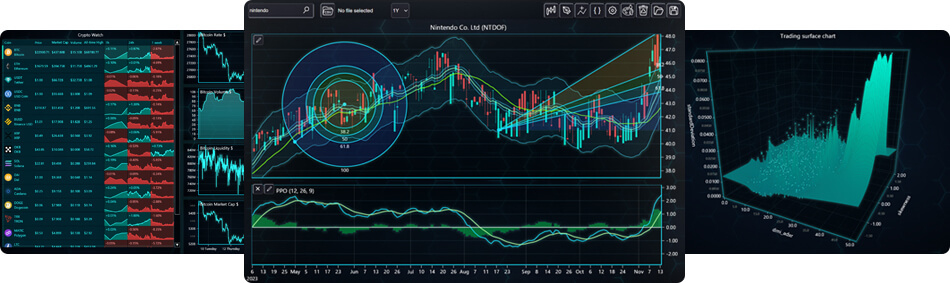
WebGL (Web Graphics Library) is a JavaScript API that allows developers to render interactive 2D and 3D graphics in web browsers without the need for plugins. It is based on OpenGL ES, a subset of the OpenGL graphics rendering API, optimized for embedded systems and mobile devices.
Key features of WebGL:
- GPU acceleration: WebGL uses the graphics processing unit (GPU) to render graphics, enabling high-performance visualizations and smoother animations compared to CPU-based rendering methods.
- Cross-platform support: WebGL works on any device with a compatible web browser, making it accessible across multiple platforms including desktops, tablets, and smartphones.
- HTML5 integration: WebGL can be easily integrated with other HTML5 features, allowing developers to create rich interactive experiences within web applications.
- Real-time rendering: WebGL supports real-time rendering, making it suitable for applications that require immediate visual response, such as games, simulations, and data visualizations.
WebGL technology is used in various fields, such as gaming, high-performance data visualization, augmented reality, and scientific studies. All this is due to its ability to process graphics with a larger amount of data, improving the experience of web applications.
WebGL’s architecture is beneficial to an application’s performance when handling large data sets. Traditional charting libraries often struggle with performance as the volume of data increases.
However, WebGL can efficiently handle real-time updates and visualizations, making it ideal for applications that require immediate insights into data, such as stock trading platforms and financial analysis tools.
Here is an example that showcases 3D bar charts and candlestick series. Two trading datasets are used to create bars based on the High-Low range and various oscillators.
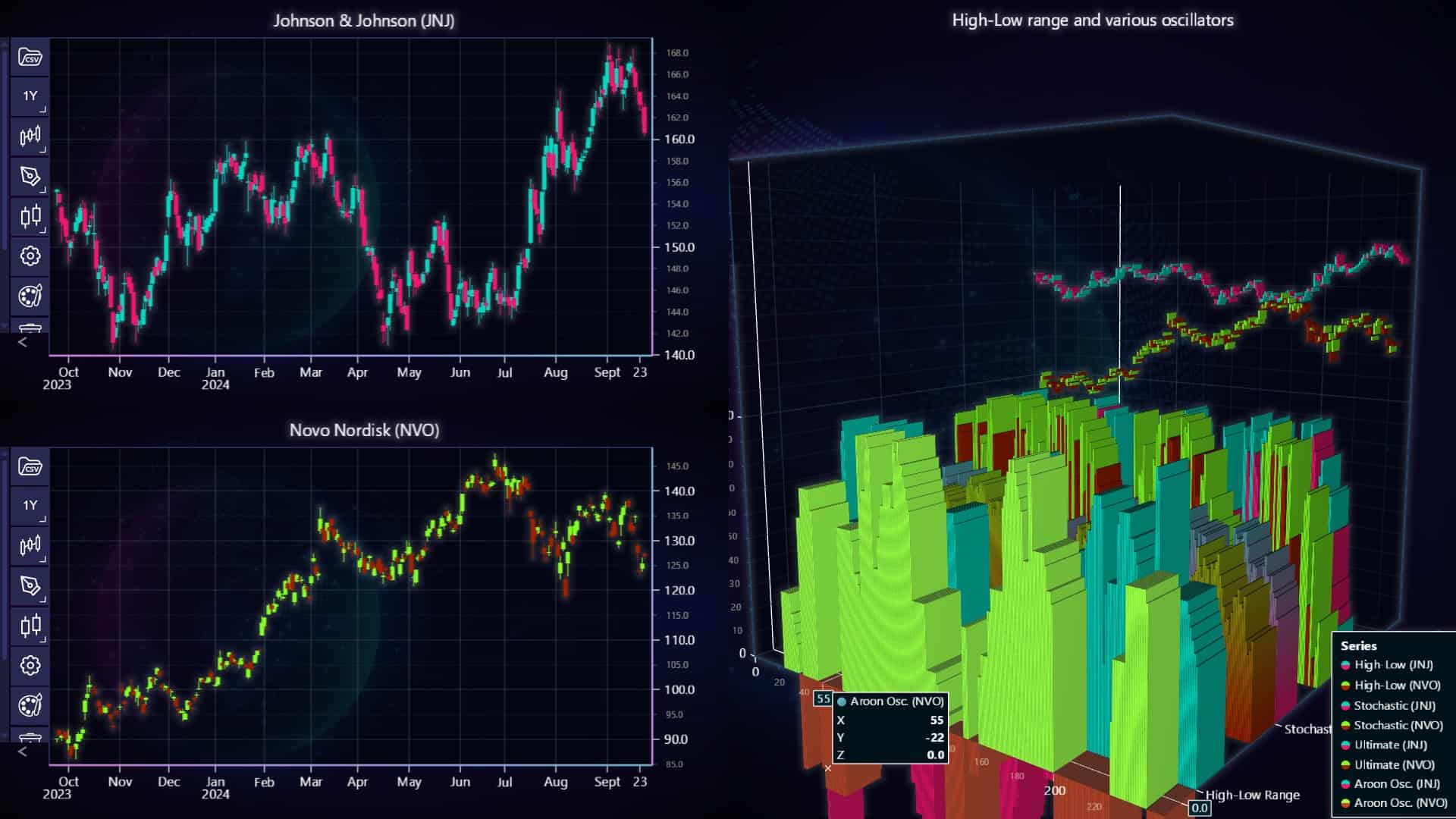
WebGL excels at creating 3D charts, which can provide richer insights into complex financial data. Imagine a 3D scatter plot that visualizes stock performance over time or interactive 3D models that represent risk factors in investment portfolios.
HTML5 vs. WebGL for Fintech Applications

Performance
- WebGL: WebGL is designed for high-performance graphics rendering and is effective at visualizing large data sets in real-time.
It leverages the GPU (graphics processing unit) for rendering, allowing for smoother animations and faster processing of complex visualizations such as 3D models and graphs.
- HTML5: While HTML5 offers a variety of features, including the <canvas> element for 2D graphics, its performance in rendering complex graphics is generally inferior to WebGL.
HTML5 is great for static data visualizations and simpler interactive elements but can struggle with highly dynamic visualizations.
Visual Complexity
- HTML5: While HTML5 offers dynamic, nice, colorful, and modern charts, its capabilities are limited to two dimensions. This is not a problem, but it does limit web applications to a single plane, and therefore, the analytical scope of data compared to a WebGL application with 3-dimensional charts.
- WebGL: As we have read above, 3D charts allow us to have a much more dynamic and precise analysis. For example, the LightningChart JS library gives us the ability to manipulate the camera, allowing us to amplify our range of vision.
The ability to manipulate and visualize data in three dimensions can reveal patterns and relationships that might not be apparent in two dimensions using basic HTML5 charts.
For example, when visualizing market trends or portfolio performance as a three-dimensional overview, allows for more complete analysis and can improve decision-making processes.
WebGL Scalability
WebGL’s scalability can be divided into handling large volumes of data and adaptability.
- High volumes of data: It is not difficult to guess that WebGL is superior to HTML5 when it comes to processing huge data sets. By not depending on the browser at all, a WebGL application can obtain data sets in various ways, as well as process these data using complex calculations in the shortest possible time.
The use of the GPU allows rendering 3D graphics without performance problems if the application is optimally programmed. These aspects are the most important in the analysis of commercial and financial data, so we can ensure that the use of WebGL technology should be considered above HTML5.
- Adaptability: WebGL enables the creation of interactive visualizations that adapt to changes in data in real-time. This means traders can explore different scenarios and gain deeper insights, improving strategic decision-making.
As platforms grow, WebGL can scale to include more advanced features, such as complex simulations or multi-variable 3D visualizations.
Application functionalities can increase and improve depending on code quality and technological advancement year after year, so a WebGL application can always improve and offer increasingly advanced experiences.
Futureproofing
Fintech systems based on modern programming technologies aim for scalability, constant support, and information security.
As I mentioned earlier, a web application based on HTML5 can be vulnerable for the user and the application. This is because access to local storage information, cookies, and cache can be easier to breach by malicious software.
On the other hand, a web application will depend on browser updates and support, so many features cannot be implemented immediately. An application with WebGL technology can work more independently since data processing and streaming can be done on the server side.
This also means that various security methods can be implemented, such as complex encryption algorithms and authentication protocol implementation. WebGL technologies can be implemented with other programming languages, which can be beneficial if they receive constant updates and support.
That said, this will allow for partnerships between various platforms, increasing the scalability of the Fintech system, whether through consumption of other data sources (APIs), security and authentication platforms, or incorporation with other devices.
A Fintech system developed with scalable, powerful technology and constant support will be able to remain stable for many years.
LightningChart JS Trader: the best Fintech charts

As a software engineer, I have had the experience of working on various projects where it is necessary to generate charts. Therefore, I can safely say that LightningChart’s technology powers the most complete and powerful libraries on the market.
For instance, the LightningChart JS library offers powerful functionalities without having to invest too much time in their implementation.
Technical information:
- Interactive line charts can visualize datasets with a maximum of 1,500 million data points.
- 10 million data points can be loaded and displayed in the blink of an eye in only 29 seconds.
- LightningChart JS displays 400 channels simultaneously with a 1,000 Hz data stream rate per channel and a 1-minute time window, adding up to a total of 24 million data points visible at every frame and updated at 60 FPS.
LightningChart JS offers you insights into its 2024 performance and how it compares to several major JS libraries on the market. In the results, you can see the comparison in processing speed for different chart types including line, scatter, area, step, and spline charts.
LightningChart JS Trader: a highly customizable Fintech library
Unlike other libraries, LightningChart JS Trader guarantees compatibility with the most widely used frameworks on the market. An important point (and perhaps my favorite) is how the implementation of LC JS happens. For example, to create a chart you only need to create an object with the type of chart you need (2D, 3D, lines, bars, points, etc.), configure some visual properties, and types of values for each axis and that’s it. This allows us to invest almost all our time in generating, processing, and formatting the data we need to analyze in our chart.
LC JS Trader offers a wide catalog of themes, which allows us to generate visually spectacular charts, without sacrificing performance or compatibility with web browsers. In case we want to implement colors, fonts, and images, LC JS Trader gives us the freedom to work with HTML components attached to our charts, or simply customize the internal components of the library.
Versatile 2D and 3D charting allows you to create custom charts and programmatically connect market data sources to any 2D or 3D chart, and monitor market data in real-time, without having to deal with delays or interruptions in user interface updates.
Support and Documentation
The documentation and extensive catalog of tutorials provide a base code with which we can start practicing, or simply add functionalities to our projects. Within these tutorials, we can demonstrate the compatibility of LC JS with web applications, mobile devices, and desktop devices.
Everything described above guarantees the scalability, sustainability, and adaptability of LC JS in our Fintech applications. Unlike other libraries on the market, Lightning Chart has given a lot of importance to support, updates, and documentation, so we will not be lost if we start using it from scratch.
Technical Analysis Charts
LightningChart JS Trader features several advanced technical chart types including Japanese Candlestick Charts, Bar Charts, Line Charts, Mountain Charts, Kagi, Renko, Point and Figure, and Heikin-Ashi Price Charts.
Among the technical indicators, you will be able to make use of Envelope Indicators, Moving Averages, Oscillators, Statistics, Trend Indicators, Volatility, and more. Drawing tools (over 30) include Fibonacci, Trend Lines, Patterns, Channels, Measurement, Text, Shapes, and more.
For building Fintech applications, we will have at our disposal high-performance and real-time 2D and 3D charting controls including XY Charts, Candlestick Charts, Bar Charts, Line Charts, Mountain Charts, Trading Charts, Geo Charts, Heatmaps, 3D Surface Charts, 3D Bar Charts, 3D Line Series, Scatter Charts, and many more. Real-time graphics allow smooth display of over 4000 graphics simultaneously at a high data rate.
Conclusion
Now that we have reviewed both HTML5 and WebGL Fintech technologies, I think it is easier to say that WebGL is much more powerful and secure than HTML5. However, this does not mean that HTML5 is a bad tool, since everything will depend on the complexity of our project.
If you only want to show two-dimensional charts, with limited interaction with the user and general information, HTML5 is a very good option, since the implementation is relatively simple compared to WebGL.
Now… WebGL is a technology with many virtues, such as 3D animations, massive data processing, data consumption between platforms, improved security, etc. Of course, for WebGL to be fully exploited, it will be necessary to use tools that allow us to properly use the resources of our GPU.
This is where LightningChart JS Trader will facilitate the development of our charts without diminishing the capabilities of our server. I recommend that you try it yourself, using the interactive 3D examples of JS Trader.
LC JS Trader is a highly scalable tool that is compatible with the most widely used frameworks on the market. Its compatibility with mobile devices will allow you to create truly impressive, advanced, and sustainable applications. On the other hand, the wide variety of charts will allow you to create tools that improve analysis and user experience.
With LC JS Trader, you will have access to the most important technical indicators, which will help analyze the performance and trends of financial assets, as well as evaluate the health and growth of fintech companies. Remember that there is a wide catalog of tutorials and videos that you can consult, as well as the documentation and interactive examples of Lightning Chart.
I hope you liked this article!
Continue learning with LightningChart
What Is LiDAR Data Visualization?
LiDAR Data Visualization The LiDAR method conveys another yet complex level of data visualization as it is widely used in demanding industries that require plotting, e.g., topographic or cartography 3D data. But the use of LiDAR goes further as it is also used...
Android
Written by a human | Updated on April 9th, 2025Android Charts Here's a new article I'm really excited about...this time, we will create an android charts data visualization application. For this application, we will work with Android Studio and LightningChart JS...

Create a JavaScript Scatter Plot
Written by a human | Updated on April 9th, 2025LightningChart JS This is a quick technical look into some interesting features of LightningChart JS XY charts and how to create an embedded scatter chat and add custom interactions to it using LightningChart JS....



If you have any questions, feel free to contact us!


©LightningChart Ltd 2026. All rights reserved.