


LightningChart JS TraderExponential Moving Average Indicator & Chart Examples
ArticleLearn about the Exponential Moving Average Indicator implementation with LightningChart JS Trader.
Written by a human | Updated on April 24th, 2025
Exponential Moving Average Indicator
The Exponential Moving Average (EMA) indicator is a technical tool widely used in stock trading to smooth out price data, making it easier to spot trends. Unlike the simple moving average (SMA), which gives equal weight to all data points, the EMA gives more weight to recent prices, making it more responsive to new information. This increased sensitivity to recent price changes makes the exponential moving average a popular choice among traders who want to quickly identify potential trends or reversals in the market.
What is an Exponential Moving Average Indicator?
An exponential moving average (EMA) is a type of weighted moving average that prioritizes recent prices over older data points. This makes it especially useful in fast-moving markets, where quick reactions to price changes are necessary. Traders often rely on the EMA indicator to identify trends and generate buy or sell signals. For example, if the price of a stock crosses above its EMA, it might indicate a buying opportunity, while crossing below the EMA could signal a potential sell-off.
Differences Between EMA and Simple Moving Average (SMA)
The primary difference between the exponential moving average and the simple moving average (SMA) is how they treat historical price data. While the SMA assigns equal weight to all data points over a specific period, the EMA assigns greater importance to the most recent prices. As a result, the EMA responds more quickly to recent price movements, making it a more dynamic indicator for real-time market analysis.
- EMA: Gives more weight to recent price data, responds quickly to price changes.
- SMA: Gives equal weight to all data points, responds slower to new price information.
Exponential Moving Average Indicator Formula
To fully understand how the exponential moving average works, it’s essential to dive into the mathematical formula behind it.
Mathematical Basis Behind the Indicator
The exponential moving average (EMA) uses a weighting multiplier that gives more importance to recent prices, making it more responsive to current price changes compared to a simple moving average. The EMA formula is calculated as follows:

Where:
- Price_today is the current price.
- EMA_yesterday is the EMA value from the previous day.
- Multiplier is the smoothing factor that adjusts the weight given to the most recent price.
The Multiplier is calculated as:

Where:
- Period refers to the number of days (or any other time unit) over which the EMA is calculated. For example, a 10-day EMA would use a period of 10.
Example (5-day EMA):
Using the same price data as above (100, 102, 104, 106, 108), let’s assume the previous EMA value is 104 (from the SMA example above).
Step 1: Calculate the multiplier:

Step 2: Calculate the EMA for the next day (price = 108):

Result: The 5-day EMA for the next day is 105.33.
To sum up, the exponential moving average is calculated by taking today’s price, subtracting the previous day’s EMA, multiplying that difference by the multiplier, and then adding the result to the previous day’s EMA. This smooths out the data while giving more weight to the most recent price points.
Interpretation of Results
The results of the EMA are often interpreted in relation to the current price of an asset. When the price crosses above the EMA, it may signal upward momentum, while crossing below the EMA could indicate a downtrend. This makes the EMA a valuable tool in spotting potential buying and selling opportunities.
Using EMA for Stock Trading

The Exponential Moving Average (EMA) is widely used by stock traders due to its ability to emphasize recent price data, making it highly responsive to market conditions. Unlike the Simple Moving Average (SMA), the EMA reacts faster to price changes, helping traders spot trends early, especially in fast-moving markets.
How to Use the EMA Indicator
To use the EMA effectively, traders plot it alongside stock price data on a chart. The relationship between the price and the EMA line helps determine the general market direction and can signal potential entry or exit points for trades:
- Uptrend: When the stock price remains above the EMA, it suggests a bullish trend, indicating the price is rising.
- Downtrend: When the price falls below the EMA, it signals a bearish trend, suggesting a decline.
Traders often customize the EMA’s time period based on their strategy. Day traders might use shorter EMAs, such as the 10-day or 20-day, for quick trades, while long-term investors may prefer a 50-day or 200-day EMA to smooth out short-term fluctuations and focus on broader trends.
Using EMA for Identifying Trends and Reversals
The EMA indicator is especially effective in spotting trends and potential market reversals. A rising EMA suggests an uptrend, while a falling EMA indicates a downtrend. These trends can be used to guide trading decisions, keeping traders in sync with the overall market direction. One of the most common methods for detecting reversals is the EMA crossover strategy, where the interaction between short-term and long-term EMAs signals changes in market momentum:
- Bullish Reversal: When a short-term EMA (e.g., 10-day) crosses above a long-term EMA (e.g., 50-day), it signals a potential upward trend and could be an entry point for buying.
- Bearish Reversal: Conversely, when a short-term EMA crosses below a long-term EMA, it indicates a possible downward trend, signaling an opportunity to sell or short.
These reversals provide timely opportunities for traders to either capitalize on a new trend or exit a trade before significant losses occur.
EMA Trading Strategies
The Exponential Moving Average is highly flexible and can be used in various trading strategies, from short-term to long-term:
- Multiple EMA Strategy: Traders often use multiple EMAs with different periods to gain insight into both short-term price movements and long-term trends. For example, a 10-day EMA might be used to track recent price changes, while a 50-day or 200-day EMA tracks the broader market trend.
- EMA Crossovers: This strategy involves monitoring the interaction between a short-term and long-term EMA to generate trading signals:
- Bullish Crossover: A shorter-period EMA crossing above a longer-period EMA (e.g., 50-day crossing above 200-day) signals upward momentum, often referred to as a “Golden Cross.” Traders view this as a strong buy signal.
- Bearish Crossover: A shorter-period EMA crossing below a longer-period EMA signals downward momentum, known as a “Death Cross.” This is typically viewed as a sell signal, suggesting that prices may decline further.
Crossovers for Entry and Exit Points
EMA crossovers are among the most reliable signals for determining entry and exit points in trades. The Golden Cross (bullish crossover) indicates that recent price momentum is overtaking longer-term trends, signaling a buying opportunity. On the other hand, the Death Cross (bearish crossover) indicates weakening price momentum, signaling a potential sell or short position. These crossover signals are often more effective when used in conjunction with other technical indicators, such as volume analysis or momentum oscillators, to avoid false signals.
The Role of LightningChart JS Trader in Financial Analysis

Financial analysis involves examining historical data to forecast future trends, make informed decisions, and assess risk. In this domain, applications like LightningChart JS Trader serve a critical role by providing real-time, high-performance data visualization tools that help traders and analysts better interpret complex datasets. It enables traders to track market trends using built-in indicators.
The platform’s ability to handle large datasets and real-time updates makes it essential for fast decision-making in dynamic markets. Additionally, its customization options allow users to create tailored charts and apply statistical indicators, enhancing both the precision of analysis and risk management. This tool helps streamline financial analysis and supports more informed, data-driven trading strategies.
Implementation with LightningChart JS Trader
Advanced charting platforms like LightningChart JS offer traders a range of technical indicators, including the Exponential Moving Average indicator. LightningChart JS allows traders to create interactive, high-performance charts, ensuring real-time data visualization. This platform is particularly useful for traders who rely on technical indicators such as STARC Bands to make quick, informed decisions.
Step 1: Get LightningChart JS Trader
To begin, you’ll need access to LightningChart JS Trader. This library provides the tools necessary to create advanced technical indicators, including Exponential Moving Average indicator. Visit the LightningChart JS Trader page to download the required components and to review the documentation.
Step 2: Review the Interactive Example
LightningChart JS Trader includes interactive examples that demonstrate how to create custom technical indicators. Start by reviewing the documentation, focusing on how to integrate Exponential Moving Average indicator into your chart setup. The interactive examples will guide you through the process of setting up the Exponential Moving Average indicator, from importing the necessary modules to modify the chart settings.
Step 3: Code Explanation
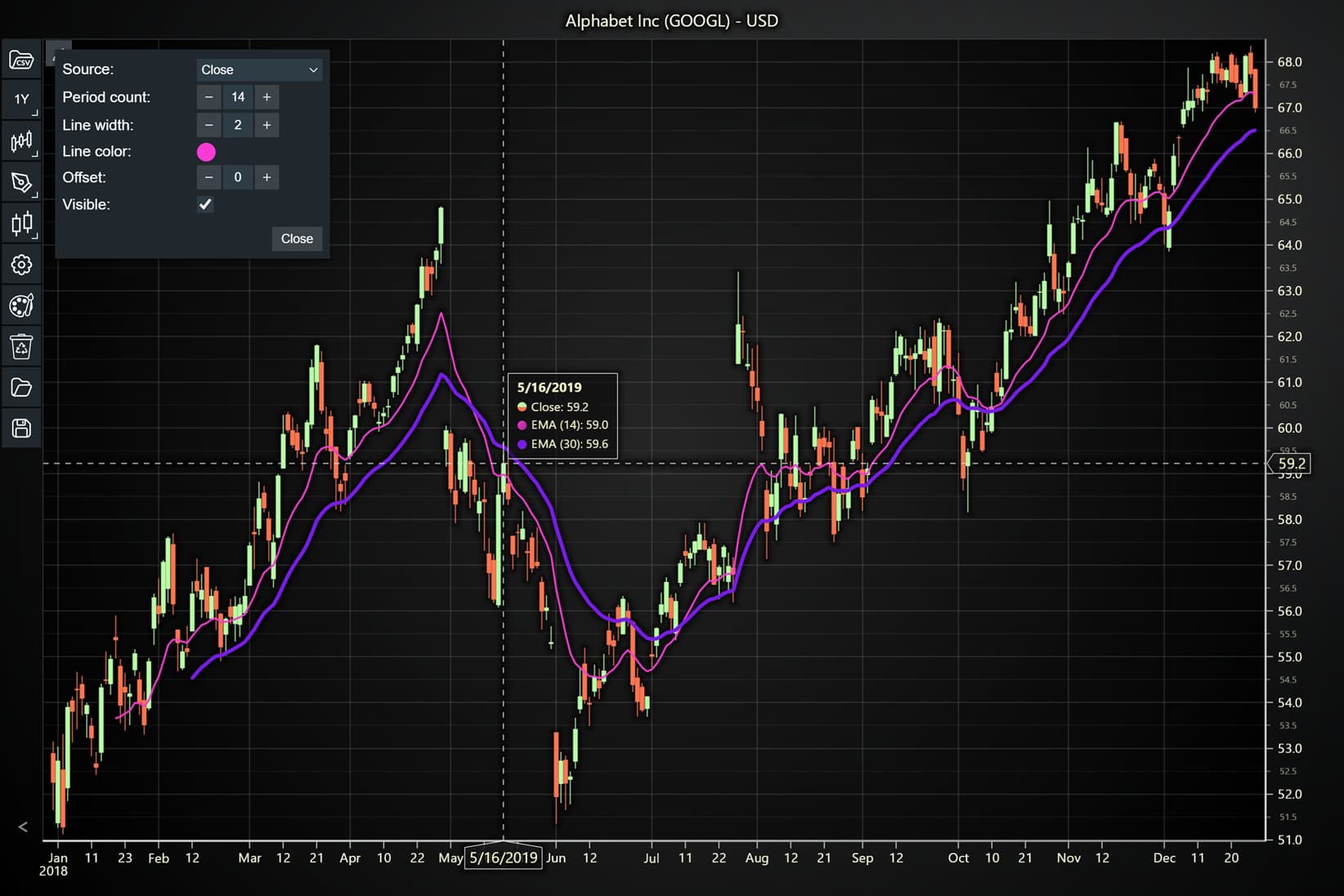
In this step, we will break down the code that creates the chart with the Exponential Moving Average indicator, as shown in the image, using LightningChart JS Trader. The code demonstrates how to initialize a trading chart, apply the Exponential Moving Average indicator, and customize its appearance.
Here’s a detailed breakdown of each section:
A. Importing the Required Libraries:
   const lcjsTrader = require('@arction/lcjs-trader')
   const lcjs = require('@arction/lcjs')
const { Themes } = lcjs- lcjsTrader: This library provides access to the LightningChart JS Trader functionalities, allowing you to create advanced financial charts.
- lcjs: The main LightningChart JS library is used for general charting functionality.
- Themes: A property within lcjs that provides access to pre-built themes. In this case, we are using the
darkGoldtheme to style the chart.
B. Initializing the Trading Chart:
lcjsTrader.trader(TRADER_LICENSE).then(async (trader) => {
    // Create a trading chart.
const tradingChart = trader.tradingChart({ loadFromStorage: false, colorTheme: Themes.darkGold })- trader(TRADER_LICENSE): Initializes the LightningChart JS Trader with the provided license key (TRADER_LICENSE). This is required to access the charting functionalities for financial data.
Note you can request a LightningChart JS Trader trial license, which is free.
tradingChart(): This function creates a trading chart with certain options. In this example:
loadFromStorage: false: This disables the loading of previously stored chart data from local storage, ensuring a fresh chart setup.colorTheme: Themes.darkGold: This applies the darkGold theme to the chart which influences the background color, grid lines, and other visual elements.
C. Adding and Customizing the Exponential Moving Average indicator
  // Add an Exponential Moving Average indicator with time period count of 14.
  tradingChart.indicators().addExponentialMovingAverage(14)

  // Adding another EMA with an alternative way of setting the period count.
  const ema30 = tradingChart.indicators().addExponentialMovingAverage()
  ema30.setPeriodCount(30)
  ema30.setLineColor('#800FF0') //Purple
ema30.setLineWidth(4)addExponentialMovingAverage(14): Adds an Exponential Moving Average (EMA) with a time period of 14, which gives more weight to recent data points over the last 14 periods.
constema30 = tradingChart.indicators().addExponentialMovingAverage(): Adds another EMA without specifying the time period initially allowing for further customization.
setPeriodCount(30): Sets the time period for the second EMA to 30, calculating the weighted average over the last 30 data points.
setLineColor('#800FF0'): Sets the line color of the second EMA to purple (#800FF0), making it stand out against other chart elements.
ema30.setLineWidth(4): Increases the line thickness of the second EMA to 4 pixels, making it easier to see on the chart.
D. Loading Data from a CSV File
    // Reading data from a file.
    await fetch(`${document.head.baseURI}examples/assets/0000/Alphabet Inc (GOOGL).csv`).then((res) => res.text()).then((text) => {
        tradingChart.readCsvString(text, 'Alphabet Inc (GOOGL)')
})fetch(): This function retrieves a CSV file containing historical data for Alphabet Inc. (GOOGL). The CSV file includes pricing information for the company’s stock, which is plotted on the chart.
readCsvString(): This function reads the CSV data and interprets it as pricing data for Alphabet Inc. The second argument (‘Alphabet Inc (GOOGL)’) sets the label for the chart, as seen at the top of the chart image.
E. Setting the Currency for the Chart
    tradingChart.setCurrency('USD')
})setCurrency('USD'): This sets the currency of the chart to USD, ensuring that the pricing data is interpreted and displayed in US dollars.
Advantages and Limitations
Advantages:
- Responsiveness: The EMA reacts more quickly to price changes, allowing traders to capitalize on short-term movements.
- Trend Confirmation: The EMA helps confirm the direction of a trend, which can be useful for long-term traders.
- Versatility: It can be applied to various asset classes, including stocks, commodities, and forex.
Limitations:
- False Signals: The EMA’s sensitivity can sometimes produce false signals during periods of market volatility.
- Lagging Nature: Despite its responsiveness, the EMA is still a lagging indicator and may not predict future price movements with perfect accuracy.
Reaction of EMA to Market Volatility
In highly volatile markets, the exponential moving average can react quickly, which can be both an advantage and a disadvantage. While it allows traders to respond to sharp price movements, it can also lead to whipsaw situations where the market reverses shortly after a signal is generated.
Conclusion
The Exponential Moving Average (EMA) is a highly valuable tool in technical analysis, particularly for traders who want to track trends, identify potential reversals, and make informed trading decisions. Its responsiveness to recent price movements makes it a go-to indicator for many active traders. Unlike the simple moving average (SMA), which applies equal weight to all data points, the exponential moving average places more emphasis on recent prices, allowing traders to better capture the most current market sentiment.
Using LightningChart JS Trader to implement the exponential moving average indicator adds significant value. LC JS Trader provides highly customizable and high-performance charting tools, allowing traders and developers to create interactive and visually appealing financial charts with real-time data updates. This makes it easier to see the effect of the EMA on stock price trends, test different trading strategies, and make quicker decisions based on reliable, clear visualizations. Incorporating LightningChart JS Trader ensures that users not only understand the EMA in theory but can also apply it practically in their stock trading analysis.
Key Takeaways:
- The EMA responds faster to price changes than the SMA, making it ideal for short-term traders.
- It is particularly useful for identifying both trends and reversals in stock markets.
- Crossovers between EMAs can signal entry or exit points for trades.
- The exponential moving average can sometimes give false signals in volatile markets, so it’s important to use it in conjunction with other indicators.
- LightningChart JS Trader offers the ability to visualize EMA and other indicators effectively, providing a robust environment for technical analysis.

Ahmad Omid
Data Science Developer


Continue learning with LightningChart

Trend Lines in Trading
Trend lines are among the simplest yet most powerful tools in technical analysis. They help traders visualize market direction, identify potential support and resistance levels, and make more informed trading decisions. Despite their simplicity, trend lines remain a...
Best Python Charting Library in 2026
Python's charting ecosystem is large, overlapping, and regularly misunderstood. Most comparison guides stop at Matplotlib, Plotly, and Seaborn. This one goes further: it covers what happens when your datasets grow large, your update rates increase, or your chart types...
Best TradingView Charting Library Alternative
TradingView's charting libraries are the most visible option for fintech developers. Visibility is not the same as capability. This guide is for developers who have hit the wall on candle count limits, watermark restrictions, branding requirements, real-time...



If you have any questions, feel free to contact us!



©LightningChart Ltd 2026. All rights reserved.