



Best D3.js Alternatives in 2026: Less Code, More Performance, Same Power
Article

Jarkko Tirkkonen
Senior Developer

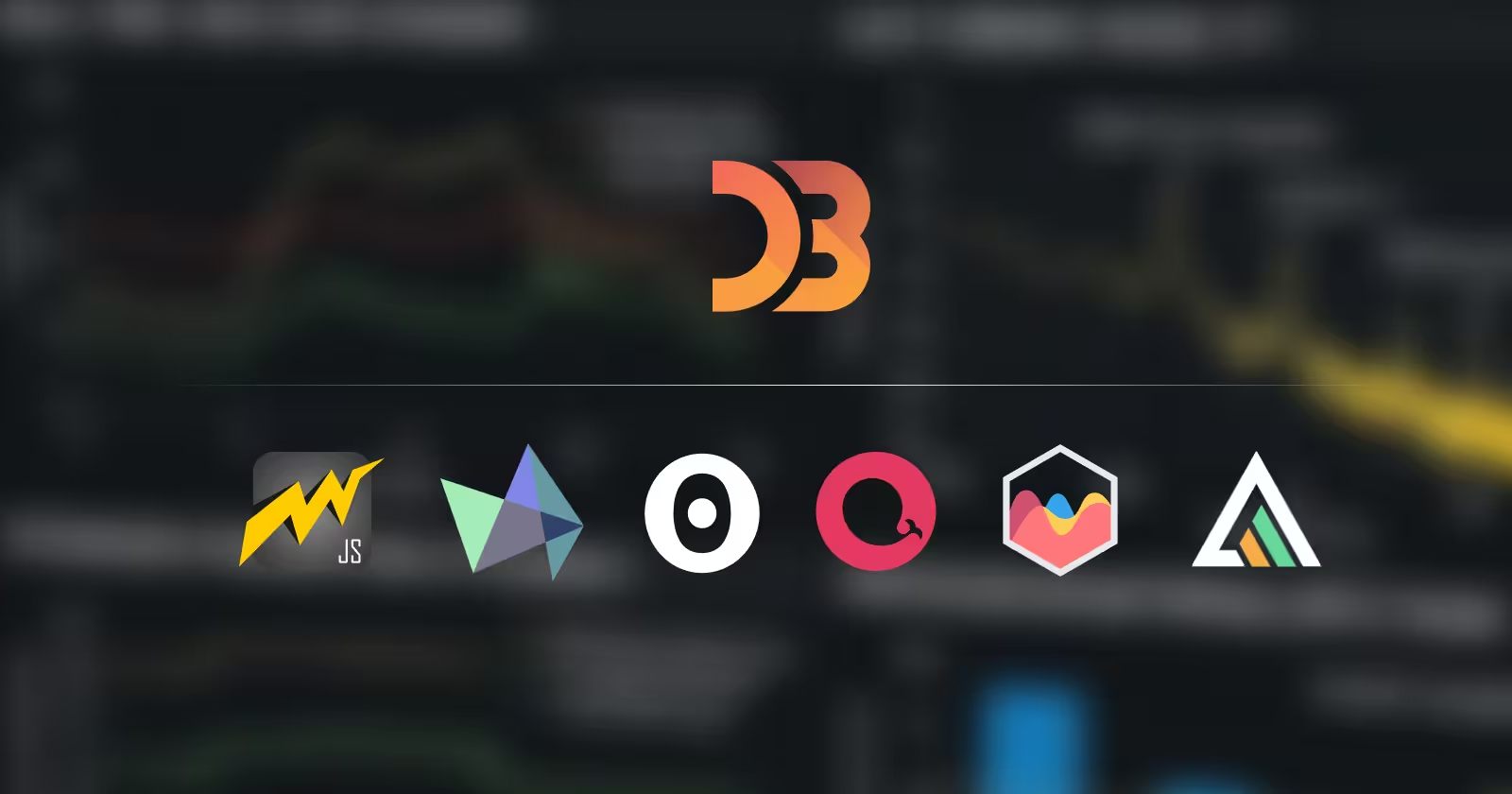
D3.js is the most starred data visualization library in existence 109,000+ GitHub stars and for justifiable reasons. It provides the building blocks to construct any visualization imaginable: data binding, SVG path generation, scale functions, geographic projections, force simulations, tree layouts. The most technically impressive interactive data journalism, research dashboards, and bespoke visualization tools on the web are built with D3. It underpins visualization work at the New York Times, The Guardian, and hundreds of research institutions.
It is also a library that requires significantly more code than any alternative to produce a standard line chart that Chart.js generates from ten lines of configuration. The SVG-by-default rendering shares the same DOM scaling limitations as every other SVG library above tens of thousands of data points. The learning curve is real D3’s data-join paradigm, selection model, scale functions, and transition system all require sustained investment before productivity arrives. And for teams whose visualization needs are met by standard chart types, D3’s power delivers diminishing returns against its complexity and maintenance costs.
1. Why Teams Look for D3.js Alternatives
Development time per chart type
A working line chart in D3 with axes, labels, tooltip, and zoom is a half-day to full-day engineering project for someone unfamiliar with D3. The same chart in Chart.js or ApexCharts is twenty minutes of configuration. In LightningChart JS it’s thirty minutes with GPU acceleration included. For standard chart types that appear on most dashboards, D3’s time cost per chart is rarely justified against the alternatives available in 2026.
This calculation shifts when the visualization is genuinely unique. A custom animated sankey with interaction behaviors that no library supports, a bespoke geographic projection not available as a pre-built chart type, a force-directed graph with custom physics for these, D3’s primitives are not just useful but necessary. The question every team should ask is: which side of that line does our visualization requirement actually fall on?
SVG performance at large data volumes
D3’s default rendering model creates SVG elements for each data point. A line chart with 10,000 points has 10,000 live SVG nodes in the document. Above ~20,000 elements, browser layout recalculations become a significant bottleneck. At 100,000 SVG elements, the page is barely interactive. At 1 million, no browser survives. Canvas rendering in D3 requires explicit reimplementation of the SVG drawing logic it doesn’t come for free.
Maintenance burden across team members
Custom D3 code requires the next developer to understand D3’s paradigms data joins, enter/update/exit, the selection model, scales, and the specific implementation choices the original author made. This is a non-trivial knowledge requirement that chart library configurations don’t impose. For teams with high turnover or mixed front-end experience, custom D3 visualizations can become expensive to maintain.
2. When D3.js Is Still the Right Choice
Before evaluating alternatives, it’s worth being honest about when D3 is genuinely irreplaceable. Use D3 when:
- The visualization is fundamentally custom a chart type that no library provides natively, a novel interaction pattern, a unique layout algorithm
- Your team has experienced frontend engineers specifically familiar with D3 who have bandwidth for custom implementation
- The visualization is a core differentiating product feature, not a supporting analytics dashboard
- You need a specific geographic projection, force simulation, or hierarchical layout that no chart library’s built-in map or tree chart provides
For everything else standard chart types on a business dashboard, analytical charts in a data product, scientific time-series visualization a chart library will reduce development time by 80–90% without sacrificing visual quality or capability.
3. Quick Comparison
| # | Library | Development time (line chart) | 10M pts | 3D | Learning curve | License |
|---|---|---|---|---|---|---|
| 1 | LightningChart JS | ~30 min | Yes 0.29s | Full GPU 3D | Moderate (imperative API) | Free non-commercial; commercial |
| 2 | ApexCharts | ~10 min | Crash | No | Low | MIT (free) |
| 3 | Apache ECharts | ~20 min | Limited | Partial | Low–Moderate | Apache 2.0 (free) |
| 4 | Chart.js | ~10 min | Crash | No | Low | MIT (free) |
| 5 | Observable Plot | ~15 min | Crash | No | Low (grammar) | ISC (free) |
| 6 | Highcharts | ~15 min | Crash | Limited | Low | $185–366/dev/yr |
| 7 | Vega-Lite | ~15 min | Crash | No | Low (grammar) | BSD-3 (free) |
4. The 7 Alternatives In Depth
1. LightningChart JS (Recommended for performance + breadth)
Rendering: WebGL/GPU | License: Free non-commercial; commercial | Chart types: 100+ including full 3D
If D3 was chosen for its power and flexibility, but SVG performance at scale has become the problem, LightningChart JS offers more performance and 100+ built-in chart types that eliminate much of the custom build work D3 requires for standard visualization. GPU rendering handles 10 million data points in 0.29 seconds a rendering architecture that D3’s SVG model cannot approach regardless of optimization effort. The native 3D suite (surface charts, 3D scatter, 3D heatmaps, 3D spectrograms) goes significantly beyond what D3 can achieve with third-party plugins.
The API is imperative rather than declarative more similar to D3’s programming model than, say, Chart.js’s configuration approach. Developers already comfortable with D3’s explicit coding style will find LightningChart JS’s API more familiar than alternatives like Vega-Lite. Official React, Vue, and Angular wrappers are maintained by the team. The free non-commercial license provides full evaluation. The cross-language family extends performance to LightningChart Python and LightningChart .NET.
2. ApexCharts
Rendering: SVG | License: MIT — always free | Notable: Best default aesthetics in the free tier
If D3 was producing visually impressive custom charts and the goal is to stop building them by hand, ApexCharts covers most standard chart types with excellent default visual quality in a fraction of D3’s implementation time. Official React/Vue/Angular wrappers. TypeScript throughout. SVG-based same performance ceiling as D3’s SVG mode, but for standard business dashboards this ceiling is rarely approached. The right choice when D3’s build overhead was the problem and performance at extreme data volumes was not.
3. Apache ECharts
Rendering: Canvas + WebGL extension | License: Apache 2.0 — always free
If D3 was chosen because it was the only library with sufficient chart type breadth custom Sankey, chord diagrams, geographic maps with specific projections Apache ECharts covers many of these at zero cost in a fraction of D3’s implementation time. Canvas-based renderer outperforms D3’s SVG at equivalent data volumes. The strongest free upgrade when D3’s type breadth was the requirement and custom implementation was the cost.
4. Chart.js
Rendering: Canvas | License: MIT – always free | Notable: Largest community, simplest API
If D3 was overkill from day one and you need standard chart types with minimal complexity, Chart.js is the fastest path from zero to a working chart. Nine chart types, declarative configuration, the largest StackOverflow coverage of any chart library, and Canvas rendering that outperforms D3’s SVG for equivalent data volumes. The right alternative when D3 was chosen due to lack of awareness of simpler options.
5. Observable Plot
Rendering: SVG / Canvas | License: ISC – always free | Notable: Created by D3’s original author, Mike Bostock
Observable Plot is the most direct evolution from D3 for teams who like D3’s design philosophy but find raw D3 too verbose. Created by Mike Bostock (D3’s original author) at Observable, it provides a concise grammar-of-graphics API mark types, channel encodings, faceting that produces standard analytical charts in dramatically less code than raw D3. Canvas-based in recent versions for better large-data performance than SVG D3. The natural first choice for D3 users who want simplicity without abandoning D3’s conceptual model.
6. Vega-Lite
Rendering: SVG (via Vega) | License: BSD-3 — always free | Notable: JSON grammar, Altair Python equivalent
Vega-Lite provides a JSON-based declarative grammar-of-graphics specification. It compiles to Vega (which D3 underlies) for SVG rendering. Concise chart specifications for standard analytical chart types. The Python equivalent Altair generates Vega-Lite specifications from Python relevant for teams wanting Python-to-web chart API consistency. SVG rendering shares D3’s performance limitations at large data volumes.
7. Highcharts
Rendering: SVG | License: $185–366/developer/year | Notable: WCAG accessibility, commercial support
If D3 was chosen because no commercial library covered the required chart types or accessibility requirements, Highcharts’ 40+ chart types are worth re-evaluating before committing to another year of custom D3 builds. WCAG 2.1/2.2 accessibility is industry-leading keyboard navigation, ARIA roles, sonification. Built-in PDF/CSV/SVG export. Commercial support SLAs. For enterprise teams where the cost of custom D3 maintenance exceeds the cost of a Highcharts license, this is frequently the right commercial library to evaluate.
5. Performance Benchmarks
Tests run in Chrome 122 (production build), mid-range hardware (Intel i7-12th gen, 16GB RAM).
Load time — line chart with various data volumes
| Library | 10K pts | 100K pts | 500K pts | 1M pts | 10M pts |
|---|---|---|---|---|---|
| LightningChart JS | ~20ms | ~40ms | ~80ms | ~120ms | 290ms |
| Apache ECharts (Canvas) | ~70ms | ~350ms | ~2,800ms | ~6,000ms | Crash |
| Chart.js (Canvas) | ~80ms | ~400ms | ~2,200ms | ~4,500ms | Crash |
| D3.js (SVG) | ~120ms | ~9,000ms | Freeze | Crash | Crash |
| D3.js (Canvas impl.) | ~90ms | ~500ms | ~2,800ms | ~5,000ms | Crash |
| Observable Plot | ~60ms | ~380ms | ~2,500ms | ~5,500ms | Crash |
6. From D3 to LightningChart JS: What Changes
D3 uses a data-join model; LightningChart JS uses imperative data addition. The conceptual shift:
D3.js line chart (SVG):
const svg = d3.select('#chart').append('svg').attr('width', width).attr('height', height);const x = d3.scaleLinear().domain([0, data.length]).range([0, width]);const y = d3.scaleLinear().domain(d3.extent(data)).range([height, 0]);const line = d3.line().x((d, i) => x(i)).y(d => y(d));svg.append('g').call(d3.axisBottom(x));svg.append('g').call(d3.axisLeft(y));svg.append('path').datum(data).attr('fill', 'none').attr('stroke', '#4fc3f7').attr('d', line);
LightningChart JS equivalent — handles 500x more data at the same speed:
import { lightningChart, Themes } from '@lightningchart/lcjs';const lc = lightningChart({ license: 'YOUR_KEY' });const chart = lc.ChartXY({ container: 'chart', theme: Themes.light });const series = chart.addLineSeries({dataPattern: { pattern: 'ProgressiveX' }});// Axes, labels, scaling, and rendering handled by LightningChartseries.add(data.map((y, x) => ({ x, y })));// Or for maximum performance: series.addArrayY(new Float32Array(data));
What you gain: GPU rendering, sub-millisecond zoom/pan at any scale, 3D capability, React/Vue/Angular wrappers, Python and .NET equivalents, no axis/scale boilerplate. What you trade: D3’s total layout flexibility for the built-in chart types that LightningChart provides. For custom layouts that aren’t in LightningChart’s catalog, D3 remains the right tool.
7. Decision Tree
- Is the visualization genuinely custom a chart type no library provides natively?
Yes: D3.js is still the right tool. Nothing replaces it for bespoke visualization.
No: Continue. - Is SVG performance at large data volumes the problem?
Yes: LightningChart JS GPU rendering handles 10M points where D3 SVG fails above 20K.
No: Continue. - Is development time per chart the problem standard chart types taking too long in D3?
Needs visual quality: ApexCharts. Needs chart breadth: Apache ECharts. Needs performance + breadth: LightningChart JS. Wants D3 creator’s simpler API: Observable Plot.
No: Continue. - Do you need 3D charts?
Yes: LightningChart JS GPU-native 3D suite, not achievable with D3 plugins at production quality.
8. FAQ
What is the easiest D3.js alternative?
Chart.js produces working charts in minutes with minimal learning curve. ApexCharts comparable simplicity with better visual defaults. Both generate standard business charts from configuration without SVG or data-join knowledge.
What is the best D3.js alternative for large datasets?
LightningChart JS. D3’s SVG renderer fails above ~20,000 elements. LightningChart JS GPU rendering handles 10 million data points in 290ms a difference in rendering architecture, not optimization level.
Is there a D3.js alternative for Python?
LightningChart Python for GPU-accelerated Python visualization in Jupyter/PyQt. Altair/Vega-Lite for grammar-of-graphics Python charting. Matplotlib for general scientific Python use. D3 itself has no Python equivalent.
Should I use D3.js or a chart library?
Use D3 when the visualization is genuinely unique and no library’s chart types can produce it the development time is justified by uniqueness. Use a chart library for everything else: standard chart types, business dashboards, analytics features. The development time and maintenance cost of custom D3 code rarely justifies itself for standard chart types in 2026.
What replaced D3.js?
D3.js has not been replaced it remains the standard for genuinely custom visualization. What has changed is that the argument for using D3 for standard chart types has weakened, because alternatives now provide GPU performance and chart breadth that weren’t available at D3’s peak adoption years. Observable Plot, by D3’s original author, provides a simpler D3-compatible API for standard analytical charts.
Further reading:
Continue learning with LightningChart

Create a JavaScript Scatter Plot
Written by a human | Updated on April 9th, 2025LightningChart JS This is a quick technical look into some interesting features of LightningChart JS XY charts and how to create an embedded scatter chat and add custom interactions to it using LightningChart JS....
HTML
Written by a human | Updated on April 9th, 2025HTML Charts with JavaScript HTML charts are standard and suitable for all-level developers with a simple implementation. The issue with basic HTML 5 charts is their limited functionalities and performance...
Volumetric Data Visualization
This article provides an overview of Volume Data, and the techniques which can be used to visualize it.





If you have any questions, feel free to contact us!
©LightningChart Ltd 2026. All rights reserved.