






QStick Chart Creation Tutorial & Theory | LightningChart JS Trader
Article
Assisted by AI
Learn how to integrate the QStick technical indicator into your trading applications with LightningChart JS Trader for improved strategies and analysis.
Ahmad Omid
Data Science Developer

Introduction to the QStick Technical Indicator
The QStick indicator is a valuable tool for traders seeking to identify trends numerically by analyzing price action. Developed by Tushar Chande, this technical indicator calculates the moving average of the difference between the Open and Close prices over a specified period. By doing so, the QStick indicator provides insights into whether the market is experiencing bullish or bearish momentum.
Unlike many other indicators that focus on volatility or momentum, the QStick helps traders determine the dominant market sentiment by smoothing out price fluctuations. This characteristic makes it particularly useful for trend-following strategies and confirming potential reversals.
Importance in Trading
The QStick indicator plays a crucial role in technical analysis by identifying periods of consistent upward or downward movement. Traders use it to:
- Spot trends early: A positive QStick value indicates bullish momentum, while a negative value signals bearish sentiment.
- Confirm reversals: When the QStick crosses above or below the zero line, it can confirm potential trend changes.
- Refine entry and exit points: By integrating it with other technical tools, traders can make informed buy or sell decisions.
This indicator is particularly useful in markets with strong trends, as it smooths out short-term fluctuations and provides a clearer picture of underlying price movements.
Formula
The QStick is calculated as follows:
QStick = MA (Close – Open, N)
Where:
- Close = Closing price of the asset
- Open = Opening price of the asset
- MA = Moving Average over period N
- N = The chosen period for the moving average
This formula essentially measures the average difference between opening and closing prices over a set period. A positive value suggests that most candles are closing above their open prices (bullish), while a negative value implies the opposite (bearish).
Interpretation
The interpretation of the QStick revolves around its zero line:
- QStick > 0: The market is in an uptrend, meaning that closing prices have generally been higher than opening prices over the selected period.
- QStick < 0: The market is in a downtrend, as closing prices are typically lower than opening prices.
- Crossing above 0: A potential buy signal, indicating a shift toward bullish momentum.
- Crossing below 0: A potential sell signal, marking a transition into bearish territory.
To improve accuracy, traders often combine the QStick indicator with moving averages, trendlines, and momentum indicators like the Relative Strength Index (RSI) or MACD.
Calculation Example
Let’s consider a 5-day QStick calculation using the following hypothetical price data:
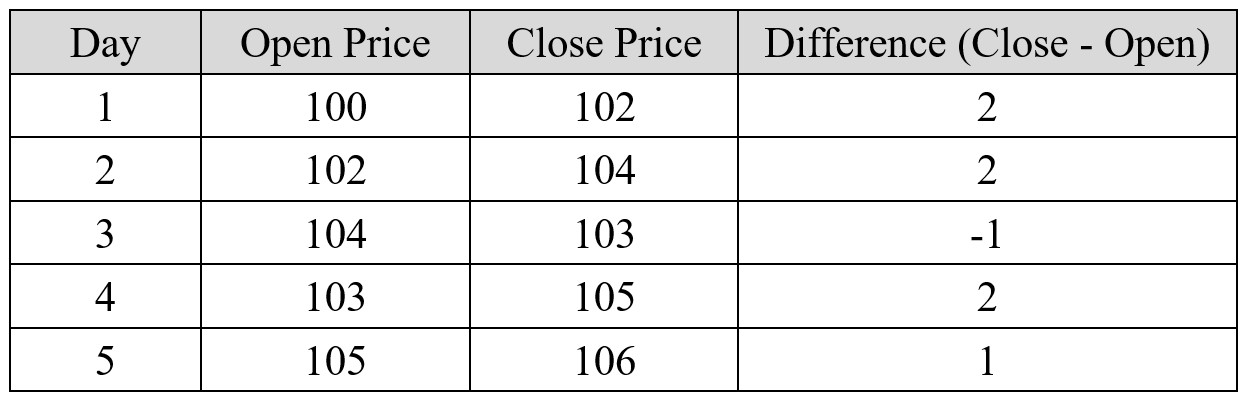
To calculate the 5-day QStick, we take the moving average of these values:
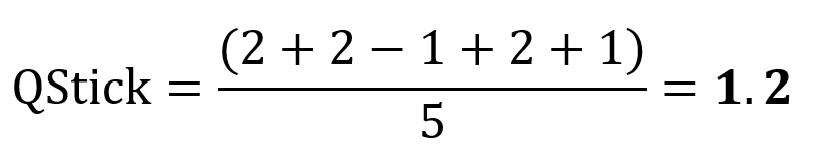
Since the QStick is positive, this suggests an overall bullish trend in the market.
How to Create the Technical Indicator Using LC JS Trader
Step 1: Get LightningChart JS Trader
To begin, you’ll need access to LightningChart JS Trader. This library provides the tools necessary to create advanced technical indicators, including the QStick Indicator. Visit the LightningChart JS Trader page to download the required components and review the documentation.
Step 2: Review the Interactive Example
LightningChart JS Trader includes interactive examples that demonstrate how to create custom technical indicators. Start by reviewing the documentation, focusing on how to integrate the QStick Indicator into your chart setup. The interactive examples will guide you through the process of setting up the QStick Indicator, from importing the necessary modules to modify the chart settings.
Step 3: Code Explanation
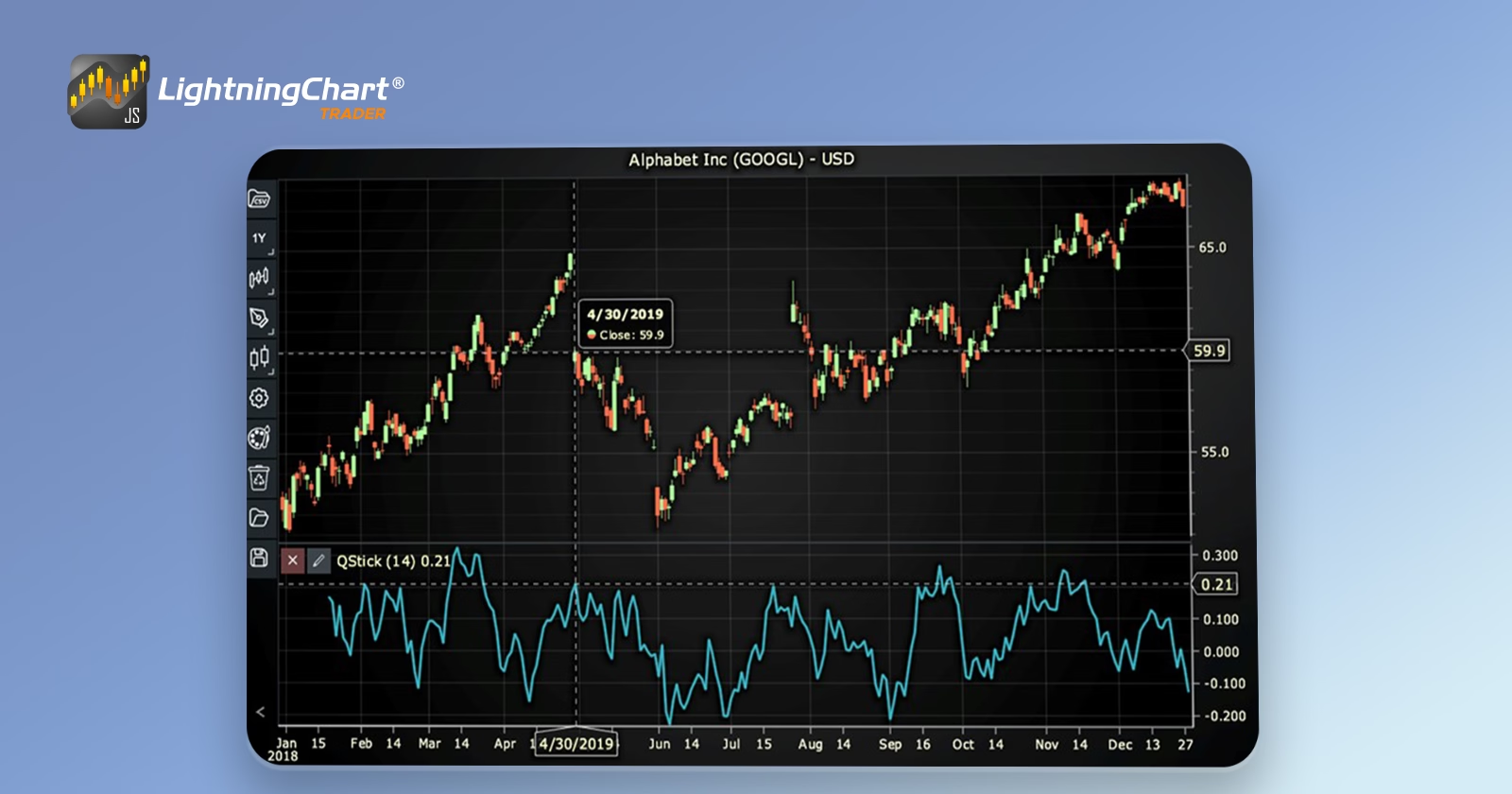
In this step, we will break down the code that creates the chart with the QStick Indicator, as shown in the image, using LightningChart JS Trader. The code demonstrates how to initialize a trading chart, apply the QStick Indicator, and customize its appearance.
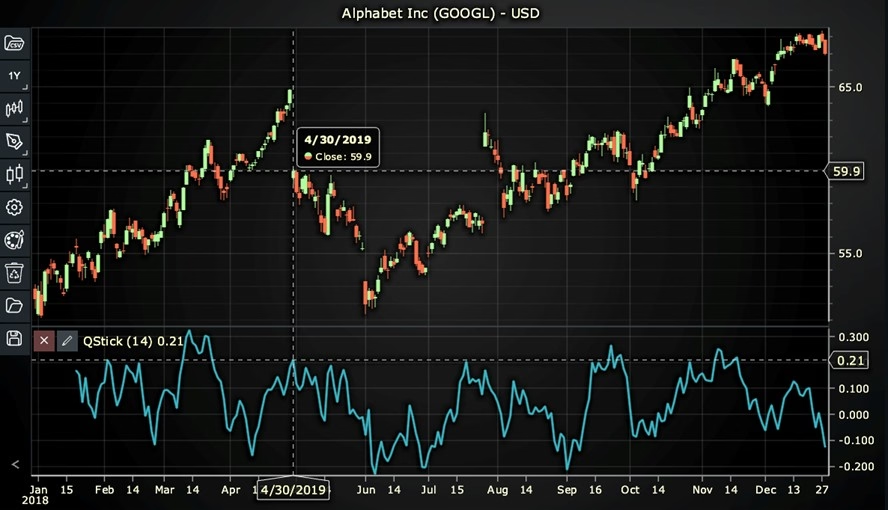
Here’s a detailed breakdown of each section:
A. Importing the Required Libraries:
   const lcjsTrader = require('@arction/lcjs-trader')
   const lcjs = require('@arction/lcjs')
const { Themes } = lcjs- lcjsTrader: This library provides access to the LightningChart JS Trader functionalities, allowing you to create advanced financial charts.
- lcjs: The main LightningChart JS library, used for general charting functionality.
- Themes: A property within lcjs that provides access to pre-built themes. In this case, we are using the darkGold theme to style the chart.
B. Initializing the Trading Chart:
   lcjsTrader.trader(TRADER_LICENSE).then(async (trader) => {
    // Create a trading chart.
const tradingChart = trader.tradingChart({ loadFromStorage: false, colorTheme: Themes.darkGold })trader(TRADER_LICENSE): Initializes the LightningChart JS Trader with the provided license key (TRADER_LICENSE). This is required to access the charting functionalities for financial data.
Note you can request a LightningChart JS Trader trial license, which is free.
tradingChart(): This function creates a trading chart with certain options.loadFromStorage: false: This disables the loading of previously stored chart data from local storage, ensuring a fresh chart setup.colorTheme: Themes.darkGold: This applies the darkGold theme to the chart, which influences the background color, gridlines, and other visual elements.
C. Adding and Customizing the Indicator
    // Add a QStick indicator
    const qstick = tradingChart.indicators().addQStick()
    qstick.setPeriodCount(14)
    qstick.setMovingAverageType(2)
    qstick.setLineColor('#3BB9C9')
qstick.setLineWidth(3)addQStick(): QStick numerically identifies trends by taking a moving average of the difference between the Open and Close prices.
qstick.setPeriodCounts(14): Sets the number of time periods (n) used to calculate the indicator.
**qstick.setMovingAverageTypes(2): Sets the types of moving averages used in QStick calculations. In this case, 2 represents the Simple Moving Average (SMA) that could be changed to another moving average types.
qstick.setLineColor('#3BB9C9'): Changes the color of the indicator line to a shade of blue.
qstick.setLineWidth(3): Sets the line thickness of the indicator to 3 pixels. This makes the line more prominent and easier to observe during analysis.
D. Loading Data from a CSV File
    // Reading data from a file.
    await fetch(`${document.head.baseURI}examples/assets/0000/Alphabet Inc (GOOGL).csv`).then((res) => res.text()).then((text) => {
        tradingChart.readCsvString(text, 'Alphabet Inc (GOOGL)')
})fetch(): This function retrieves a CSV file containing historical data for Alphabet Inc. (GOOGL). The CSV file includes pricing information for the company’s stock, which is plotted on the chart.readCsvString(): This function reads the CSV data and interprets it as pricing data for Alphabet Inc. The second argument (‘Alphabet Inc (GOOGL)’) sets the label for the chart, as seen at the top of the chart image.
E. Setting the Currency for the Chart
    tradingChart.setCurrency('USD')
})setCurrency('USD'): This sets the currency of the chart to USD, ensuring that the pricing data is interpreted and displayed in US dollars.
** Enumeration of Moving Average Types in LC JS Trader:
- Exponential Moving Average (EMA): 0
- None: 1 (No moving average applied)
- Simple Moving Average (SMA): 2
- Time Series Moving Average (TSMA): 3
- Triangular Moving Average (TMA): 4
- Variable Moving Average (VMA): 5
- Variable Index Dynamic Average (VIDYA): 6
- Volume Weighted Moving Average (VWMA): 7
- Weighted Moving Average (WMA): 8
- Welles Wilder’s Smoothing (WWS): 9
Advantages and Limitations of the Indicator
Advantages and Limitations of the Indicator
The QStick indicator offers several advantages for traders looking to identify and confirm trends in the market. One of its primary benefits is its ability to provide clear trend identification by smoothing out price movements.
Unlike more volatile indicators, the QStick allows traders to visualize trends more effectively, making it a valuable tool for those who prefer a structured approach to market analysis. Additionally, it is easy to calculate and interpret, relying on a simple moving average rather than complex mathematical models. This accessibility makes it suitable for both beginners and experienced traders who want a quick and reliable measure of market sentiment.
Furthermore, the QStick indicator is particularly effective when used for trend confirmation, especially when combined with other indicators like the Moving Average Convergence Divergence (MACD), Relative Strength Index (RSI), or Bollinger Bands. It can also be applied across different timeframes, making it a versatile tool for day traders, swing traders, and long-term investors alike.
However, the QStick does have some limitations that traders should consider. One of its main drawbacks is its lagging nature, as it is based on moving averages. This can result in delayed signals, making it less effective in fast-moving markets where immediate reactions are required.
Additionally, the QStick indicator may produce false signals in choppy or sideways markets, as it does not account for sudden price spikes or whipsaws. Traders should be cautious when relying on it in low-volatility conditions, as it may not accurately reflect real market trends.
Finally, while the QStick is a valuable tool on its own, it is most effective when used in conjunction with other technical indicators. Relying solely on QStick without additional confirmation could lead to misinterpretations and poor trading decisions.
Conclusion
The QStick indicator is a powerful yet straightforward tool for identifying trends and confirming market direction. By analyzing the average difference between open and close prices, traders gain valuable insights into market sentiment. Whether used as a standalone tool or in combination with other indicators, the QStick can help traders refine their buy and sell decisions effectively.
For those looking to visualize the QStick indicator in action, LightningChart JS Trader provides an interactive charting solution to implement and customize this indicator seamlessly. By integrating LC JS Trader, users can enhance their technical analysis and make data-driven decisions with precision.
Continue learning with LightningChart
Andrews’ Pitchfork in Technical Analysis
Andrews' Pitchfork is one of the most respected technical analysis tools used by traders to identify potential support and resistance levels, trend direction, and future price paths. Developed by Dr. Alan H. Andrews, the indicator is based on the principle that prices...
React Charting Performance
Here's a scenario that plays out across development teams every few months. Someone builds a React dashboard, picks Recharts or Victory because they're popular, the devs love them, and the first demo looks great. Then the dataset gets bigger. Or the data starts...

Javascript Charting Library comparison 2026
Every year someone publishes a listicle of JavaScript charting libraries. They screenshot a demo, note the GitHub stars, paste in the npm install command, and call it a day. Then you follow their recommendation, get six months into your project, and discover that your...



If you have any questions, feel free to contact us!



©LightningChart Ltd 2026. All rights reserved.