


Performance Index Indicator for Technical Analysis
Article
Assisted by AI
Learn how to implement the Performance Index Indicator in your software to track and compare price changes across securities over time.
Ahmad Omid
Data Science Developer

Performance Index Indicator
Technical analysis relies on indicators to evaluate market trends, analyze price behavior, and make informed trading decisions. Among these, the Performance Index stands out as a valuable tool.
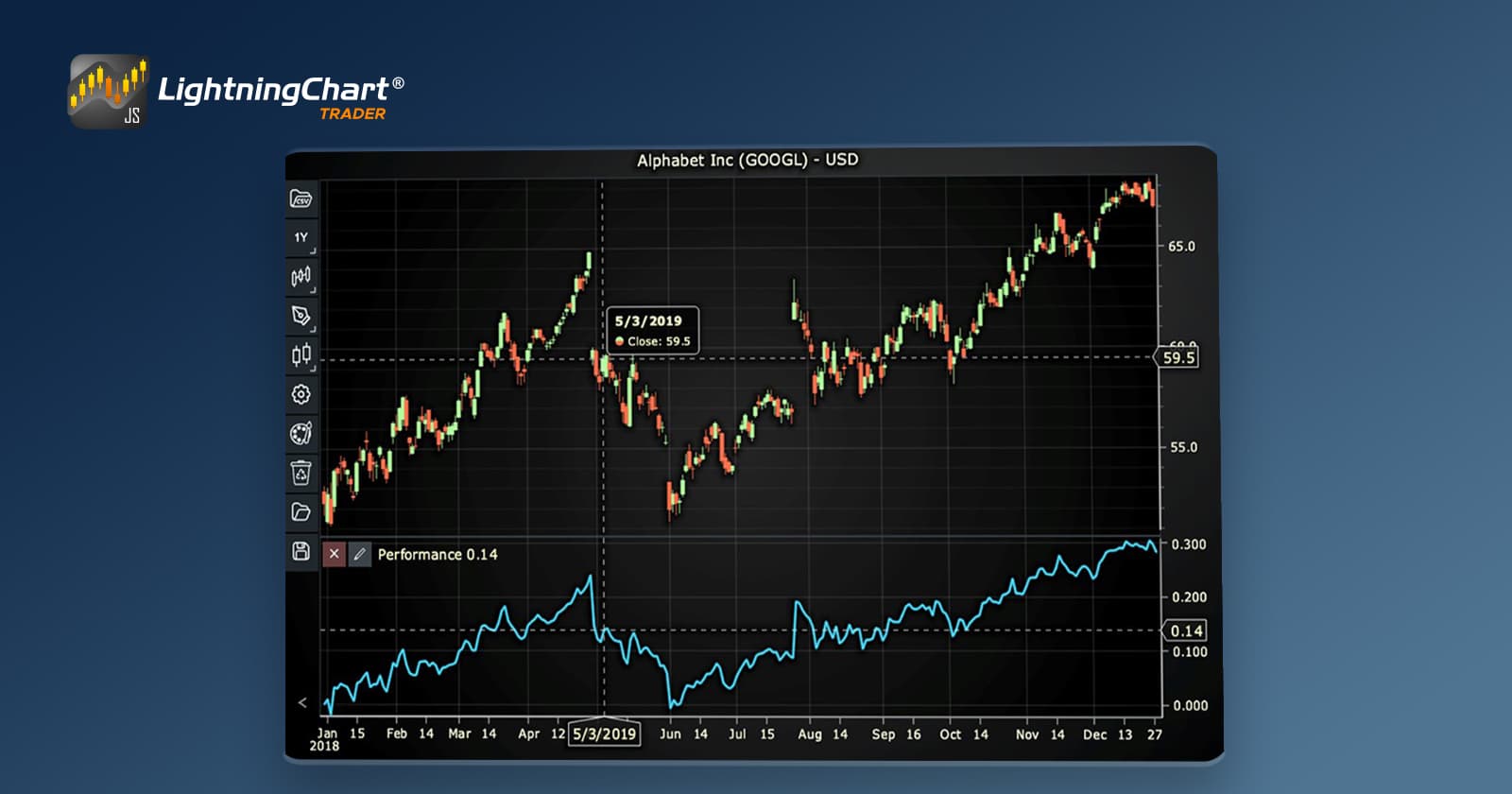
The Performance Index Indicator helps traders and analysts compare price changes across securities by displaying how much the price has changed since the first period. This normalization of price movements allows for an effective comparison of different securities on the same scale.
This indicator often referred to as a Performance Indicator, measures how a security’s price has changed relative to its starting value. It is commonly used by traders to assess asset performance and compare different securities within a portfolio or market sector.
History
The concept of analyzing price changes relative to an initial reference point has long been a part of technical analysis. Early traders sought ways to evaluate performance trends across markets without being influenced by absolute price values.
Over time, the Performance Index Indicator emerged as a standard tool for monitoring long-term trends and assessing market dynamics by tracking changes in price rather than absolute values.
Indicator Usage in Technical Analysis
The Performance Index Indicator is a vital tool in technical analysis due to its ability to standardize data for comparison. It is commonly used to:
- Compare securities: Traders use it to identify which stocks, sectors, or asset classes are performing better relative to others.
- Analyze trends: The indicator helps determine whether a security is experiencing upward or downward momentum.
- Monitor portfolio performance: Investors can track asset performance to optimize portfolio allocation.
- Inform trading decisions: The indicator helps identify opportunities where a security’s relative performance aligns with broader market movements.
How Does Performance Index Indicator Work?
The Performance Index Indicator works by tracking the change in price from an initial reference point, making it easier to analyze how a security has performed over time. This method allows traders to compare performance without being influenced by differences in price scale.
Formula
The formula for the Performance Index is:

Where:
- Current Price represents the latest price of the security.
- Initial Price refers to the price of the security at the first period (baseline).
The result indicates how the price has changed in relation to its initial value.
Interpretation
- A value greater than 1 indicates an increase in price compared to the initial reference point.
- A value less than 1 means the price has decreased since the first period.
- A value of exactly 1 suggests no change in price from the baseline.
-
Key Components
- Baseline Reference: The initial price is essential since all future calculations are based on it.
- Timeframe Selection: The indicator’s effectiveness depends on the chosen timeframe, whether for short-term trading or long-term investing.
- Standardized Comparison: Using a relative performance measure allows for effective comparison across different securities.
How to Create the Technical Indicator Using LC JS Trader
Step 1: Get LightningChart JS Trader
To begin, you’ll need access to LightningChart JS Trader. This library provides the tools necessary to create advanced technical indicators, including the performance index Indicator. Visit the LightningChart JS Trader page to download the required components and review the documentation.
Step 2: Review the Interactive Example
LightningChart JS Trader includes interactive examples that demonstrate how to create custom technical indicators. Start by reviewing the documentation, focusing on how to integrate the performance index Indicator into your chart setup. The interactive examples will guide you through the process of setting up the performance index Indicator, from importing the necessary modules to modify the chart settings.
Step 3: Code Explanation
In this step, we will break down the code that creates the chart with the performance index Indicator, as shown in the image, using LightningChart JS Trader. The code demonstrates how to initialize a trading chart, apply the performance index Indicator, and customize its appearance.
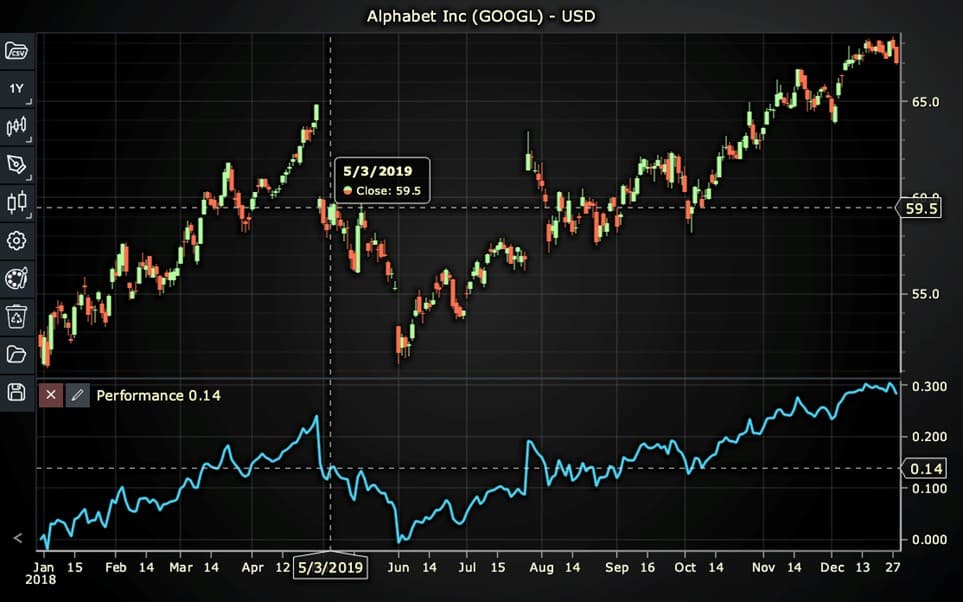
Here’s a detailed breakdown of each section:
A. Importing the Required Libraries:
   const lcjsTrader = require('@arction/lcjs-trader')
   const lcjs = require('@arction/lcjs')
const { Themes } = lcjs- lcjsTrader: This library provides access to the LightningChart JS Trader functionalities, allowing you to create advanced financial charts.
- lcjs: The main LightningChart JS library, used for general charting functionality.
- Themes: A property within lcjs that provides access to pre-built themes. In this case, we are using the darkGold theme to style the chart.
B. Initializing the Trading Chart:
   lcjsTrader.trader(TRADER_LICENSE).then(async (trader) => {
    // Create a trading chart.
const tradingChart = trader.tradingChart({ loadFromStorage: false, colorTheme: Themes.darkGold })trader(TRADER_LICENSE): Initializes the LightningChart JS Trader with the provided license key (TRADER_LICENSE). This is required to access the charting functionalities for financial data.
Note you can request a LightningChart JS Trader trial license, which is free.
tradingChart(): This function creates a trading chart with certain options.loadFromStorage: false: This disables the loading of previously stored chart data from local storage, ensuring a fresh chart setup.colorTheme: Themes.darkGold: This applies the darkGold theme to the chart, which influences the background color, gridlines, and other visual elements.
C. Adding and Customizing the Indicator
    // Add a Performance Index indicator
    const pi = tradingChart.indicators().addPerformanceIndex()
    pi.setSource(3)
    pi.setLineColor('#47DAFF')
pi.setLineWidth(3)addPerformanceIndex(): It displays how much the price has changed since the first period.
**pi.setSource(3): Sets which values the indicator calculations are based on. In this case, calculations based on Close values.
pi.setLineColor('#47DAFF'): Changes the color of the indicator line to blue.
pi.setLineWidth(3): Sets the line thickness of the indicator to 3 pixels. This makes the line more prominent and easier to observe during analysis.
D. Loading Data from a CSV File
    // Reading data from a file.
    await fetch(`${document.head.baseURI}examples/assets/0000/Alphabet Inc (GOOGL).csv`).then((res) => res.text()).then((text) => {
        tradingChart.readCsvString(text, 'Alphabet Inc (GOOGL)')
})fetch(): This function retrieves a CSV file containing historical data for Alphabet Inc. (GOOGL). The CSV file includes pricing information for the company’s stock, which is plotted on the chart.readCsvString(): This function reads the CSV data and interprets it as pricing data for Alphabet Inc. The second argument (‘Alphabet Inc (GOOGL)’) sets the label for the chart, as seen at the top of the chart image.
E. Setting the Currency for the Chart
    tradingChart.setCurrency('USD')
})setCurrency('USD'): This sets the currency of the chart to USD, ensuring that the pricing data is interpreted and displayed in US dollars.
** Enumeration Source in LC JS Trader:
To select which values the indicator calculations are based on.

Advantages and Limitations of the Indicator
The Performance Index Indicator offers several advantages for traders and analysts. It provides a standardized method for comparing securities, making it easier to identify outperforming and underperforming assets.
It is also an excellent tool for trend analysis, allowing traders to track price movements over time. Additionally, its simple calculation and interpretation make it accessible to traders of all experience levels.
Despite its benefits, the indicator has some limitations. Its dependence on the chosen timeframe means that different periods can produce varying results, requiring traders to align it with their strategy.
The indicator also does not account for external factors such as market conditions, trading volume, or economic data, which can impact price movements. Furthermore, if the initial reference price is poorly chosen, the results may not accurately reflect actual performance trends.
Lastly, while useful for tracking past performance, it does not predict future price movements and should be used alongside other technical analysis tools.
Conclusion
The Performance Index Indicator is an essential tool for technical analysts and traders, allowing them to assess price changes relative to a baseline value. Its ability to normalize data makes it particularly useful for comparing securities, tracking trends, and informing trading decisions. Despite some limitations, its simplicity and effectiveness make it a valuable addition to any trader’s toolkit.
For those interested in creating the Performance Index Indicator, LightningChart JS Trader provides an excellent environment for practical implementation. It is a high-performance charting library designed for financial and technical analysis, featuring prebuilt indicators like moving averages, RSI, and MACD. It allows users to easily build custom Indicators while benefiting from real-time data rendering and interactive features like zooming and customizable timeframes.
The library’s comprehensive documentation and tutorials make it accessible for both beginners and experienced developers. By leveraging LightningChart JS Trader, you can create responsive, visually compelling charts and combine the Performance Index with other tools for enhanced trend analysis and portfolio evaluation. This makes it a reliable and essential resource for successful financial analysis.
Continue learning with LightningChart

Trend Lines in Trading
Trend lines are among the simplest yet most powerful tools in technical analysis. They help traders visualize market direction, identify potential support and resistance levels, and make more informed trading decisions. Despite their simplicity, trend lines remain a...
Best Python Charting Library in 2026
Python's charting ecosystem is large, overlapping, and regularly misunderstood. Most comparison guides stop at Matplotlib, Plotly, and Seaborn. This one goes further: it covers what happens when your datasets grow large, your update rates increase, or your chart types...
Best TradingView Charting Library Alternative
TradingView's charting libraries are the most visible option for fintech developers. Visibility is not the same as capability. This guide is for developers who have hit the wall on candle count limits, watermark restrictions, branding requirements, real-time...



If you have any questions, feel free to contact us!
©LightningChart Ltd 2025. All rights reserved.