






LightningChartEnvelope Technical Indicators
ArticleLearn about the 9 different types of Envelope indicators used for financial and stock trading technical analysis.
Written by a human | Updated on April 22nd, 2025
Envelope Technical Indicators
Hello!
Today, we will review an interesting topic that I believe we should consider when performing stock trading and financial data analysis since it will allow us to understand the commercial behavior of financial markets.
This will be the first in a series of articles related to technical analysis in financial markets. For now, we will only review theory, but it will serve as an introduction to how to use the new LightningChart Trader and its advanced technical analysis charts.
What are Envelope indicators?
Envelope stock trading and financial indicators are visual tools that allow us to identify trends, reversal points, overbought, and oversold conditions. Here are some key terms to understand Envelope indicators:
- The Tendency is the preference that leans toward a specific end.
- The trend has its reversal point, which breaks the alignment of highs and lows, which makes it impossible to predict the following price changes.
- The overbuying and overselling conditions are established based on the sales behavior of a product.
When an asset is trading near established lows, it’s said that it is oversold, whereas overbought indicates that the price of an asset is at the top of its range. If you remember from previous LightningChart tutorials, we mostly use XY-type charts, such as Line charts, CandleStick, Thresholds, etc. Well, with these tools plus Envelope indicators, we will be able to carry out market analysis and locate various types of envelope indicators. In almost all indicators, three or two parallel lines will be used. These lines delimit the highest and lowest values and the average values.

MAE (Moving Average Envelope)
The Moving Average Envelope (MAE) is the most basic indicator, which uses only two lines. The parallel lines help interpret trends in the market and are placed above and below a moving average.
This moving average can be based on the closing and opening prices or highs and lows. In the following indicators, we will see the use of several moving averages, which influence the difference of each of them.
Bollinger Band
This indicator was developed by technical trader John Bollinger, and the objective of this indicator is to identify when an asset is overbought or oversold.
Bollinger bands are made up of three lines:
- Middle Band (Simple Moving Average).
- Upper Band.
- Lower Band.
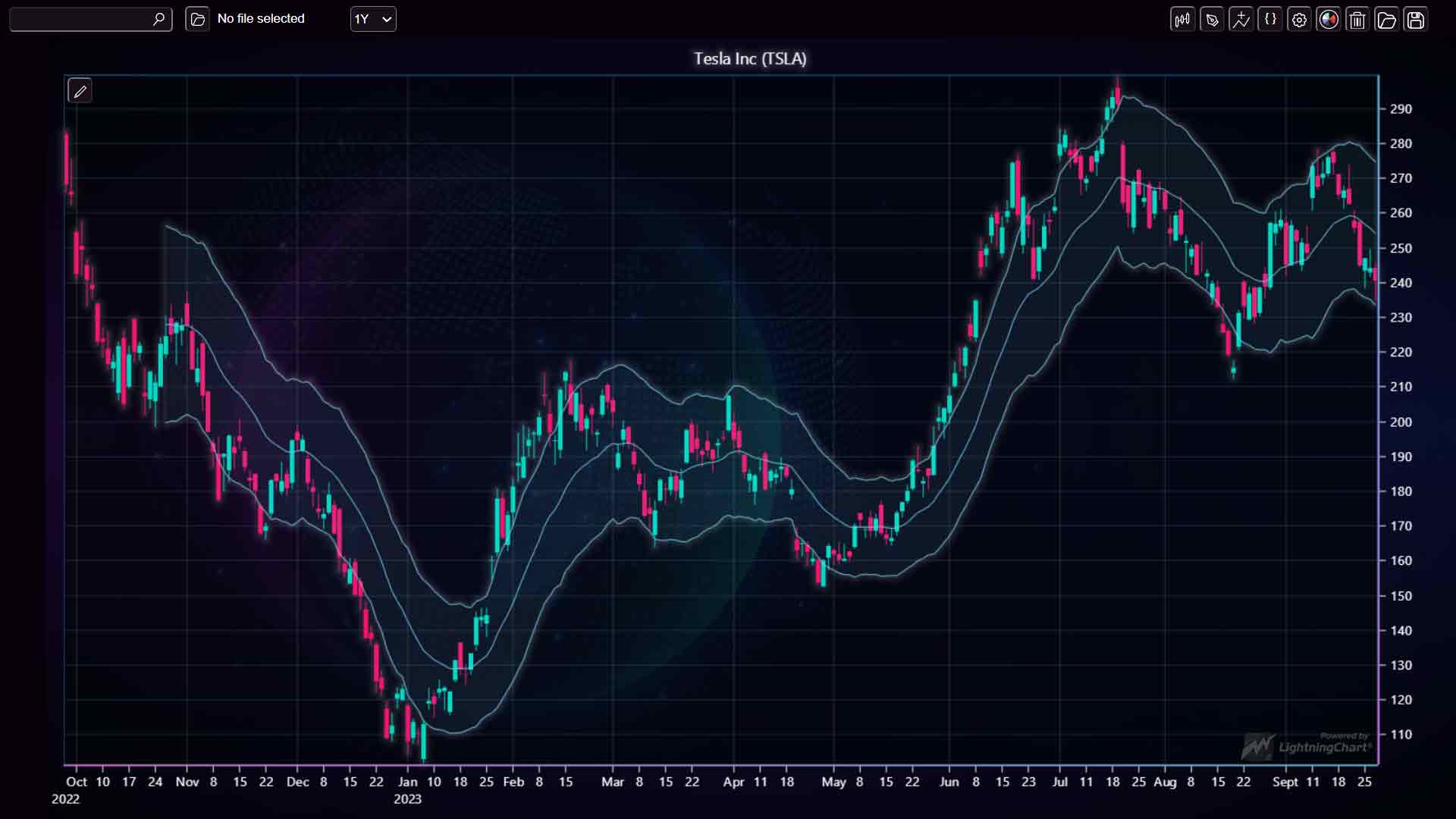
The upper and lower bands will serve as limits to identify oversold or overbought. Here’s an example of a Bollinger Band and how to add it to a chart on the LightningChart Trader:

As we mentioned above, if the asset approaches the upper band, this indicates that it is overbought and if it approaches the lower band, it indicates that it is oversold. Bollinger bands are calculated based on the asset’s simple moving average (SMA). Usually, the average SMA is based on 20-day results.
Here’s the formula to calculate Bollinger bands:
Upper band = 20-day SMA + (20-day SD x 2)Middle band = 20-day SMALower band = 20-day SMA – (20-day SD x 2)
Donchian Channels
The definition of Donchian channels can be very similar to that of Dollinger bands. In both cases, we have 3 lines: upper, middle, and lower one.

The difference between both indicators is that Donchian aims to plot the 3 channels and show the highest high, the lowest low, and the midline between both channels. This goal is to locate the trends in a more graphic and understandable way for the analyst.
Dollinger Bands plots 3 bands based on a simple moving average (SMA). The use of a mathematical calculation offers a more stable and less shocking result in the 3 channels shown. Another point to mention is that Dollinger bases his average on a short period of time, for example, 20 days, while Donchian focuses on longer periods which can affect the analysts’ impression.
Fractal Chaos Bands
This indicator is one of the most useful on a personal level, especially in the search for conclusions based on the comparison of past trends against current ones. Like the previously explained indicators, the Fractal Chaos Bands (FCB) indicator, establishes an upper fractal line based on the highest values, while the lower fractal line is based on the lowest values. The result is a type of grid drawn on a graph with a current period. With this grid, we can compare the current period against the FCB period.

As shown in the image above, the fluctuation between periods can be identified very quickly, thanks to the superimposed grid. This indicator can be used with the same period but with different products or competitors. The result can be quite graphically impressive and helps a lot to understand trends among competitors.
High-Low Bands
This indicator aims to show price volatility in the stock market. It helps make buying and selling decisions based on a concept called Triangular Moving Average. The moving average smoothes the asset price curve, cushioning variations due to volatility. The triangular moving average shows the average price of an asset over a given number of data points, typically a number of price bars.
The bands establish a range that allows you to interpret buying and selling conditions. These conditions are established by the operators, depending on the magnitude of the variations with respect to the average.

Keltner Channels
This volatility indicator is named after its creator, trader Chester Keltner. It is usually compared to Bollinger bands because it also consists of 3 lines. Even though both technical indicators have 3 lines, they are generated based on different conditions.
Keltner uses an exponential moving average (EMA) and two outside lines based on the average true range (ATR). Unlike the SMA, where the values are added and divided by their number, the EMA has the condition that the weight of the last values will be exponentially greater than that of the previous ones.

This is with the objective that the result is closer to the highest value, preventing rebounds sooner.
Prime Number Bands
Developed by Modulus Financial Engineering Inc., it aims to show a difference between only the prime numbers of a series. This applies to the maximum and minimum bands. The difference is represented with a graph which covers both bands.
If this chart constantly points to the upper band, it indicates that the market is safe and pointing upwards. If the chart points to the lower band, it indicates that the market is unstable and volatile.

Standard Error Bands
The Standard Error Bands show the trend and volatility. As in other indicators, here we have 3 bands:
- Smoothed linear regression line: Period linear regression curve smoothed by a 3-period simple moving average.
- Upper error band: The linear regression line plus 2 standard errors.
- Lower error band: The linear regression line minus 2 standard errors.
When the bands contract, it indicates that the value is maintained and the trend can continue. When the bands expand, it indicates that the trend is beginning to end.

Stoller Average Range Channel (STARC) Bands
The Stoller Average Range Channel indicator aims to establish a “normal” price limit. Any value that goes beyond this limit would mean the growth or decline of a trend. STARC uses a simple moving average (SMA) as an average to establish both bands. The upper band is the sum of the average true range (ATR) value, while the lower band is created by subtracting the ATR value from the SMA.
Formula:
STARC Band+=SMA+(Multiplier×ATR)
STARC Band−=SMA−(Multiplier×ATR)
where:
SMA=Simple moving average, with length typically between five and 10 periods
ATR=Average True Range
Multiplier=Factor to apply to ATR – two is common but can be adjusted for personal preference

Conclusion
In this article, we had a brief introduction to the Envelope technical indicator for stock trading. This topic is somewhat complicated or confusing, especially if you have no prior knowledge. Consider that the use of mathematics is essential to generate moving averages. The moving averages are what will help us establish an average for the upper and lower bands.
The result of each moving average will depend on how risky or considerable we want our maximum and minimum bands. Having these bands, we will be able to interpret the overbought and oversold levels.
If the average is exponential, we will have parallel lines further away from our series, which would give us a wider margin before reaching a point of very high or very low trend.
The average that is required to be used will depend on the plans or goals that the seller needs. If I could give a definition for this type of tool, it would be to create and display a range above the values of a series. This range will help establish a limit over which to know if the values are stable, are increasing in trend, or are losing value.
A series allows us to see values that rise and fall but does not indicate whether the fluctuations are within a stable range or exceed the average value set by the trader.
Visually, the Envelope indicator is a tool that expands the vision of the behavior of a market. A current example would be the digital currency market (such as bitcoin), where it is common to have to use these indicators.
These indicators help in a very intuitive way, to know the trend in the value of currencies, and to know when to buy or sell. Thank you for having come this far! In the next article, we will see more examples of moving averages.
I recommend that you follow this content, as it will serve as an introduction to the new LightningChart Trader.

Omar Urbano
Software Engineer


Continue learning with LightningChart

EEG Chart
Written by a human | Updated on April 10th, 2025EEG Chart The human brain is one of the most complex and fascinating structures in the world. Scientists have been studying the brain for years to better understand how it works and to find ways to diagnose and...

Best WPF Charting Library
Written by a human | Updated on April 10th, 2025What is the best WPF charting library? WPF (Windows Presentation Foundation) is a graphical subsystem in .NET for building Windows desktop applications. It provides rich graphical capabilities, allowing developers...
Choosing the right XY line series
LightningChart .NET features 10 different line series. Read more about their characteristics and functionalities and choose the best for your app.



If you have any questions, feel free to contact us!



©LightningChart Ltd 2026. All rights reserved.