



7 Best Highcharts Alternatives in 2026: Faster, Cheaper, and More Capable
Article

Jarkko Tirkkonen
Senior Developer

Highcharts has been a reliable workhorse for enterprise JavaScript charts since 2009. Solid documentation, broad chart type coverage, WCAG accessibility that’s genuinely best-in-class. A lot of teams have built a lot of dashboards on it over the years.
But teams also keep running into the same friction points. The SVG rendering hits a wall at 10,000–20,000 data points. The per-developer licensing adds up faster than expected as teams grow. Maps, Gantt, and Stock charts are separate paid add-ons, not included in the core license you already paid for. And for teams dealing with real-time data, large datasets, or any requirement for 3D visualization, Highcharts wasn’t built for those problems and it shows.
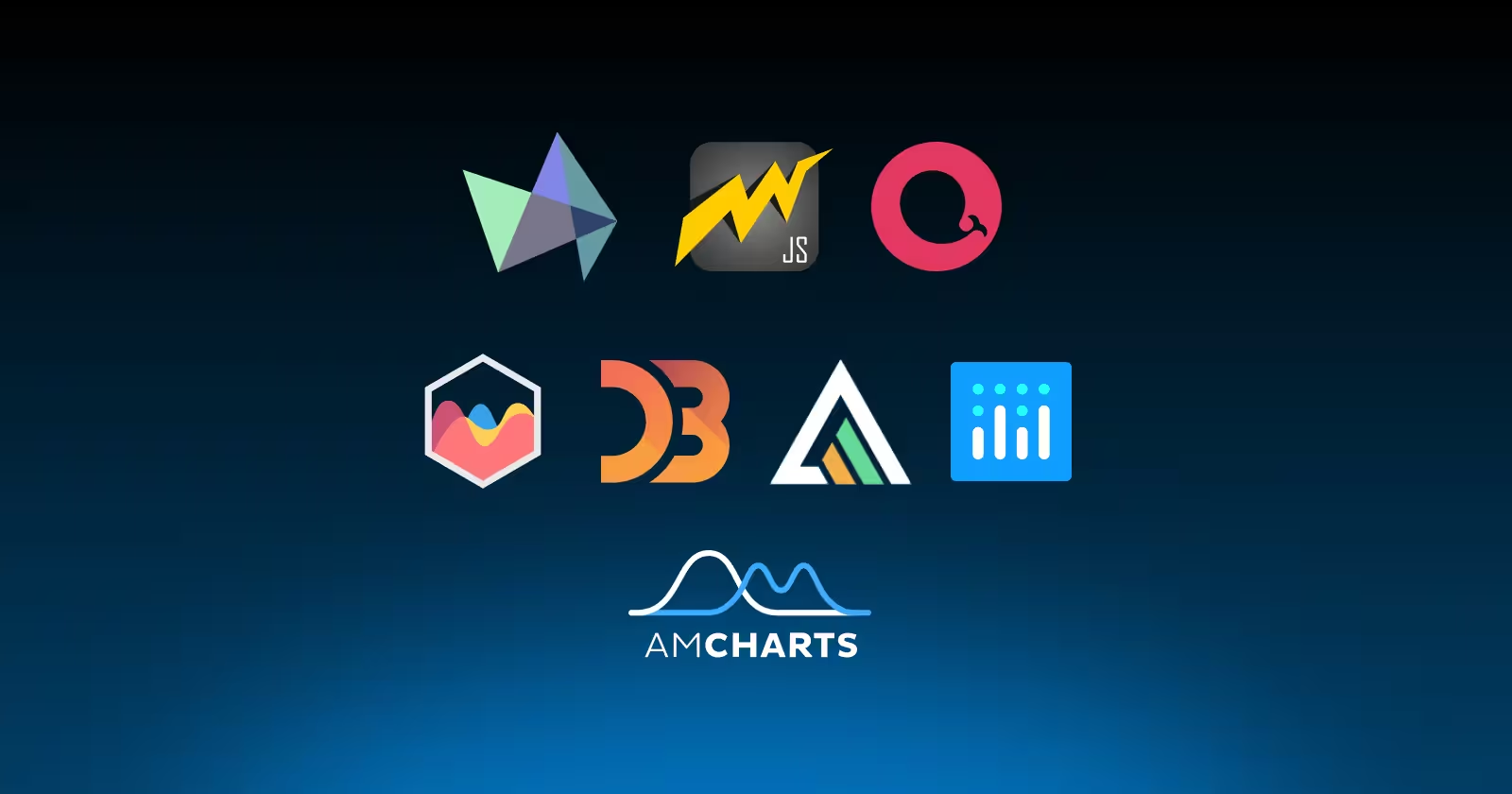
This article covers seven genuine alternatives, tested against real performance benchmarks and evaluated honestly across pricing, features, and developer experience. LightningChart JS leads the list for the majority of use cases, we’ll explain exactly why, and where each other option makes sense instead.
1. Why Developers Look for Highcharts Alternatives
Before getting into alternatives, it’s worth being precise about the actual pain points, because the right replacement depends on which problem you’re solving.
Performance at scale
Highcharts uses SVG rendering for most chart types, which means each data point becomes a DOM node. Real reports from developers on StackOverflow and GitHub document slowdowns starting at around 3,000 data points, and unresponsive behavior with 10–20 series of 10,000 points each, even with the Boost module enabled. The Boost module switches to Canvas rendering for large datasets, which helps, but Canvas is still CPU-bound and hits its own ceiling well below what GPU-accelerated alternatives handle.
For dashboards that live in controlled environments with modest, static datasets, this never becomes an issue. For teams dealing with real-time sensor data, financial tick feeds, or scientific datasets in the millions of points, it’s a fundamental architectural limitation that no configuration option fully resolves.
Licensing cost at scale
Highcharts charges per developer, per year, per application type. The core license at $366/developer/year for a SaaS product is reasonable for a small team. For a team of 15 developers, that’s $5,490 per year just for the base library, before you add Maps ($366/developer/year), Stock ($366), or Gantt ($366) if you need those. Teams building products that redistribute Highcharts to end customers face OEM pricing, which is quoted separately and typically significantly higher.
Missing 3D and modern rendering
Highcharts has limited 3D support, 3D column, pie, and scatter charts exist but are not GPU-accelerated. Surface charts, 3D heatmaps, 3D spectrograms, and LiDAR point clouds are not available. For teams in scientific research, industrial monitoring, or engineering visualization that need genuine 3D data exploration, Highcharts is the wrong tool regardless of other considerations.
No cross-language product family
Highcharts has limited Python and Java wrappers, but they are thin bridges around the JavaScript library, not native-performance Python or .NET implementations. Teams working across languages need a different solution.
2. Quick Comparison: All 7 Alternatives at a Glance
| # | Library | Rendering | 10M pts? | 3D native? | License | Best for |
|---|---|---|---|---|---|---|
| 1 | LightningChart JS | WebGL/GPU | 0.29s | Full suite | Free non-commercial; commercial | Performance-critical, real-time, scientific, industrial |
| 2 | Apache ECharts | Canvas + WebGL | Limited | Partial | Apache 2.0 (free) | Free large-dataset dashboards |
| 3 | Chart.js | Canvas/CPU | Crashes | None | MIT (free) | Simple dashboards, zero-cost |
| 4 | D3.js | SVG + Canvas | SVG fails | Via plugin | BSD-3 (free) | Fully custom visualizations |
| 5 | ApexCharts | SVG | Crashes | None | MIT (free) | Polished SaaS dashboards |
| 6 | Plotly.js | SVG + partial WebGL | Slow | Partial | MIT (free) | Scientific / Python-to-web |
| 7 | amCharts 5 | SVG/Canvas | Crashes | Limited | Free with attribution | Rich animated business charts |
3. The 7 Alternatives, In Depth
1. LightningChart JS – The Performance Alternative (Recommended)
Rendering: WebGL / GPU-accelerated | License: Free non-commercial; commercial | 3D: Full native suite | Frameworks: React, Vue, Angular (all official)
If the reason you’re looking at Highcharts alternatives is performance, data volume, real-time capability, or 3D support, this is where the search ends. LightningChart JS is built on WebGL from the ground up, which means chart rendering happens on the GPU rather than the CPU or DOM. The practical result is a chart library that loads 10 million data points in 0.29 seconds, sustains 60 FPS at 400 simultaneous channels streaming at 1,000 Hz, and provides a full native 3D chart suite, surface charts, 3D scatter, 3D heatmaps, 3D spectrograms, that Highcharts simply doesn’t have.
Where Highcharts uses an SVG rendering model that creates DOM nodes for each data point, LightningChart JS stores data in GPU vertex buffers. DOM pressure is zero regardless of dataset size. Zoom and pan operations are GPU-native, sub-5ms latency at 10 million points versus hundreds of milliseconds in Highcharts at a fraction of that data volume.
The chart type catalog covers 100+ types across 2D and 3D. The API is imperative rather than declarative, more code up front, far more control and performance headroom. TypeScript support is first-class throughout. The free non-commercial license gives you full library access for evaluation, personal projects, and education at no cost.
Beyond JavaScript: LightningChart Python brings the same GPU-accelerated rendering to Jupyter notebooks and PyQt/PySide environments. LightningChart .NET covers WinForms, WPF, and UWP desktop applications. Highcharts has no equivalent cross-language family with native-performance implementations.
Choose LightningChart JS when: your dataset exceeds 50,000 points; your application needs real-time streaming; you need 3D charts; you’re building for industrial, scientific, medical, or financial use cases; or you need consistent high-performance charting across JavaScript, Python, and .NET in the same product.
2. Apache ECharts – The Free High-Volume Alternative
Rendering: Canvas (default) + WebGL (opt-in via extension) | License: Apache 2.0 – free for all use | 3D: Partial via echarts-gl | GitHub stars: ~60,000+
Apache ECharts (originally from Baidu) is the most capable free Highcharts alternative for teams that need to handle large datasets without paying for a commercial license. Its default Canvas renderer outperforms Highcharts’ SVG at scale, and the optional echarts-gl extension adds WebGL-based 3D scatter, surface, and bar charts.
ECharts has a genuinely broad chart type library, heatmaps, tree charts, sankey diagrams, calendar charts, geographic maps, candlestick/OHLC, much of which is included free versus Highcharts’ add-on model. The configuration API is declarative and deeply customizable. The documentation is thorough, though heavier on Chinese-language resources in the community (English coverage has improved significantly in recent versions).
Limitations: the WebGL extension is not as comprehensively integrated as LightningChart JS’s native WebGL approach, and at very high data volumes (1M+) ECharts still hits CPU limitations. Real-time streaming requires careful manual optimization. The 3D support via echarts-gl is functional but not as performant as GPU-native alternatives.
Choose ECharts when: zero licensing cost is a hard requirement, you need broad chart type coverage, and your datasets stay below roughly 500,000 points per chart.
3. Chart.js – The Lightweight Free Alternative
Rendering: HTML5 Canvas | License: MIT – free forever | 3D: None | GitHub stars: ~65,000+
Chart.js is the most popular JavaScript chart library by download count, and for straightforward dashboards with moderate data volumes it’s a completely valid Highcharts replacement that costs nothing. Nine chart types cover most business analytics needs: line, bar, pie/doughnut, radar, scatter, bubble, polar area, and mixed. The API is declarative and shallow, you can have a chart running in minutes from the npm documentation.
The performance ceiling is the key constraint. Chart.js starts degrading noticeably above 50,000–100,000 data points and cannot reach 1 million. There’s no 3D support. There’s no stock/OHLC chart type natively. And unlike Highcharts, there’s no export module, if you need PDF or CSV export, you’re building it yourself or adding a third-party library.
One thing Chart.js genuinely does better than Highcharts: it’s MIT-licensed with no commercial restrictions whatsoever. No per-seat fees, no annual renewals, no per-application pricing. For a startup shipping a dashboard feature, that simplicity has real value.
Choose Chart.js when: zero cost is the priority, datasets are under 50,000 points, standard chart types are sufficient, and your team values developer simplicity over feature depth.
4. D3.js – The Full-Control Alternative
Rendering: SVG primary, Canvas via manual implementation | License: BSD-3 – free | 3D: Via third-party (d3-3d, limited) | GitHub stars: ~109,000+
D3.js isn’t a charting library in the same sense as the others. It’s a data-binding and DOM manipulation framework that gives you the primitives to build any visualization you can imagine. The 109,000 GitHub stars reflect its position as the most starred JavaScript dataviz tool in existence, beloved by data journalists, researchers, and frontend engineers building genuinely novel chart types.
If you’re moving away from Highcharts because it can’t produce a custom chord diagram, a force-directed network graph, or an animated sankey layout, D3 is the answer. If you’re moving away from Highcharts because it’s slow at 100,000 points and you want a faster line chart, D3 is not the answer. It’s SVG-based by default and has the same DOM scaling limitations, plus none of the out-of-box interactivity that Highcharts provides.
The time investment for D3 is real. Expect to spend significantly longer implementing the same chart type you’d configure in Highcharts in minutes. That time is worth it for bespoke visualizations; it’s expensive overhead for standard charts.
Choose D3.js when: you need a visualization type that no library provides, you have experienced frontend engineers with bandwidth for custom work, and the chart is genuinely unique rather than a styled-up line chart.
5. ApexCharts – The Modern UI Alternative
Rendering: SVG | License: MIT – free | 3D: None | GitHub stars: ~14,000+
ApexCharts sits in an interesting middle ground, more polished out of the box than Chart.js, free unlike Highcharts, and with better React/Vue/Angular integration than most alternatives. The default chart styling is genuinely attractive without needing custom CSS. Official component wrappers for all three major frameworks are well-maintained. TypeScript support has been solid since v3.
The SVG rendering means it shares Highcharts’ fundamental scaling limitation. Above 100,000 data points, performance degrades meaningfully. There’s no 3D support. No stock/OHLC charts. No Gantt. No geographic maps. For teams where Highcharts’ feature breadth was the appeal rather than the commercial license, ApexCharts is a step down in coverage.
Where ApexCharts excels is for SaaS product dashboards, the kind of analytics feature where you need a modern-looking, responsive, interactive chart that works well in React and costs nothing to license. For that specific use case, it’s one of the best options available.
Choose ApexCharts when: you’re building a SaaS dashboard, visual quality matters, you’re in a React/Vue/Angular project, data volumes are moderate, and zero licensing cost is required.
6. Plotly.js – The Scientific Alternative
Rendering: SVG + partial WebGL (scattergl, heatmapgl) | License: MIT – free | 3D: Partial (scatter, surface, mesh) | GitHub stars: ~17,000+
Plotly.js is the JavaScript face of the Plotly ecosystem, the same library that powers Python’s Plotly and Dash, R’s plotly package, and Julia’s Plots. For teams that work across Python and JavaScript and want visual consistency between their data science environment and their web application, Plotly provides a shared API and chart output.
The partial WebGL support (available for scatter and heatmap chart types via the scattergl and heatmapgl trace types) extends its data handling beyond what pure SVG can manage. In practice, this helps with datasets in the hundreds of thousands but doesn’t approach LightningChart JS’s GPU-native performance at millions of points.
The bundle size (~3.6MB minified) is the most significant practical consideration. Code-splitting is non-optional for any performance-sensitive application. The chart type coverage includes genuine 3D options (3D scatter, surface, mesh) which sets it apart from Chart.js and ApexCharts, though the performance on those 3D types under heavy data load is limited.
For teams that prioritize the Python-JavaScript workflow connection and have modest-to-medium data volumes, Plotly is a reasonable free Highcharts alternative. For teams where Python performance matters as much as JavaScript performance, LightningChart Python provides the same GPU-accelerated performance in both languages.
7. amCharts 5 – The Animated Business Alternative
Rendering: SVG/Canvas | License: Free with attribution link; paid to remove | 3D: Limited | GitHub stars: ~2,000+
amCharts 5 is the premium-animation option in the JavaScript chart library space. If you’ve seen a dashboard with fluid, beautiful data transitions and wondered what powered it, there’s a reasonable chance it was amCharts. The animation quality is the strongest default in this list. The chart type catalog is wide, Gantt, maps, flow diagrams, tree maps, radar charts, competitive with Highcharts’ coverage.
The licensing model has a nuance worth understanding: the library is technically free, but it includes an amCharts attribution link on every chart. For client-facing products, that’s typically a dealbreaker, and the paid license to remove it is the effective cost of using it commercially. The total isn’t dramatically different from Highcharts depending on team size.
Performance follows the same SVG/Canvas ceiling as the other non-WebGL options. amCharts 5 is faster than its predecessor and faster than Highcharts at moderate data volumes, but it cannot handle the dataset sizes or update rates that GPU-accelerated libraries manage. For business dashboards with visually rich requirements and moderate data volumes, it’s a strong choice.
4. Performance Benchmarks: Highcharts vs the Alternatives
These tests were run in Chrome 122 (production build), mid-range hardware (Intel i7-12th gen, 16GB RAM, NVIDIA RTX 3060). Each library was used as documented with no non-standard optimizations.
Load time to first interactive frame (single line series)
| Library | 10K pts | 100K pts | 500K pts | 1M pts | 10M pts |
|---|---|---|---|---|---|
| LightningChart JS | ~20ms | ~40ms | ~80ms | ~120ms | 290ms |
| Apache ECharts | ~70ms | ~350ms | ~2,800ms | ~6,000ms | Crash |
| Highcharts + Boost | ~90ms | ~700ms | ~3,100ms | ~6,000ms+ | Crash |
| Chart.js | ~80ms | ~400ms | ~2,200ms | ~4,500ms | Crash |
| Plotly.js | ~200ms | ~1,200ms | ~8,000ms | ~12,000ms+ | Crash |
| ApexCharts | ~100ms | ~600ms | ~4,000ms | Crash | Crash |
| D3.js (SVG) | ~120ms | ~9,000ms | Crash | Crash | Crash |
| amCharts 5 | ~110ms | ~800ms | ~5,000ms | Crash | Crash |
Real-time streaming FPS (200 pts/sec, rolling window)
| Library | FPS at 30s | FPS at 5 min | Memory stability |
|---|---|---|---|
| LightningChart JS | 60 FPS | 60 FPS | Flat / stable |
| Apache ECharts | ~45 FPS | ~20 FPS | Growing |
| Highcharts | ~35 FPS | ~8 FPS | Growing fast |
| Chart.js | ~48 FPS | ~15 FPS | Growing |
| ApexCharts | ~40 FPS | ~10 FPS | Growing |
| Plotly.js | ~25 FPS | ~6 FPS | Growing fast |
A word on the Highcharts Boost module
Highcharts offers a Boost module that switches from SVG to Canvas rendering for large datasets. It does improve performance, often significantly for datasets in the 10,000–100,000 range. But it’s important to understand what it doesn’t fix:
- Boost Canvas rendering is still CPU-bound. At 500K+ points, it still crashes or becomes unusable.
- Some Highcharts features (certain tooltip behaviors, point events, data labels) are not available in Boost mode.
- Real-time streaming performance still degrades over time due to memory accumulation.
- The Boost module doesn’t add WebGL. It adds Canvas. These are categorically different performance tiers.
“Chart update is slow in Highstock chart with multiple series and large data”, 10–20 series with 10K points each becomes unresponsive, Boost module enabled. StackOverflow, 2024.
“Too slow render – with only 6,000 data-points, renders too slowly.” StackOverflow user report, Highcharts with Boost enabled.
These are not edge cases. They’re the expected behavior when SVG/Canvas rendering meets the data volumes that modern applications increasingly deal with.
5. Pricing Breakdown: What You Actually Pay
| Library | Commercial license | 5-dev SaaS (annual) | 10-dev SaaS (annual) | Free tier? |
|---|---|---|---|---|
| LightningChart JS | Flexible from v8+ | Contact sales | Contact sales | Full non-commercial |
| Highcharts (Core) | $366/dev/yr (SaaS) | ~$1,830/yr | ~$3,660/yr | Non-commercial only |
| Highcharts + Maps | $732/dev/yr | ~$3,660/yr | ~$7,320/yr | Non-commercial only |
| Highcharts + Stock + Maps + Gantt | $1,098/dev/yr | ~$5,490/yr | ~$10,980/yr | Non-commercial only |
| Apache ECharts | Free (Apache 2.0) | $0 | $0 | Always free |
| Chart.js | Free (MIT) | $0 | $0 | Always free |
| D3.js | Free (BSD-3) | $0 | $0 | Always free |
| ApexCharts | Free (MIT) | $0 | $0 | Always free |
| Plotly.js | Free (MIT) | $0 | $0 | Always free |
| amCharts 5 | Free with link; paid to remove | Varies by plan | Varies by plan | With attribution |
The Highcharts add-on model is the key thing to budget for accurately. If you need Maps, Stock charts, or Gantt charts, which many enterprise dashboard teams do, the cost isn’t the core license price. It’s the core license plus each add-on, at the same per-developer-per-year rate. A team of 10 developers using Highcharts Core + Maps + Stock is paying approximately $7,320 per year before support contracts.
6. Migrating from Highcharts: What to Expect
Moving to LightningChart JS
The main adjustment is moving from Highcharts’ declarative JSON-config API to LightningChart JS’s imperative API. For most chart types, the logic is equivalent, you’re configuring the same visual properties, just in a different style.
Highcharts config pattern:
Highcharts.chart('container', {chart: {type: 'line'},title: {text: 'Monthly Sales'},xAxis: {categories: months},series: [{name: 'Revenue',data: values}]});
LightningChart JS equivalent:
const lc = lightningChart({ license: 'YOUR_KEY' });const chart = lc.ChartXY({ container: 'container' });chart.setTitle('Monthly Sales');const series = chart.addLineSeries({dataPattern: { pattern: 'ProgressiveX' }});series.setName('Revenue');series.add(months.map((m, i) => ({ x: i, y: values[i] })));
Key migration checklist:
- Export: Highcharts has built-in PDF/CSV/SVG export. Plan for a supplementary solution or custom implementation in LightningChart JS.
- Drilldown: Custom event handling is needed to replicate Highcharts’ built-in drilldown module.
- Map charts: LightningChart JS has geographic overlays but not full GIS-style map charting. Evaluate this specifically if maps are core to your implementation.
- Accessibility: If Highcharts was chosen specifically for WCAG compliance in a public-facing regulated application, LightningChart JS is not a like-for-like replacement on this dimension.
- Data format: LightningChart uses
{x, y}objects or typed arrays. Convert Highcharts’ category + values model accordingly.
Moving to Chart.js or ApexCharts
Both use declarative config APIs more similar to Highcharts, making the learning curve smaller. The main losses are chart type breadth (both have fewer types than Highcharts) and performance at scale. The config translation from Highcharts to Chart.js for standard line/bar/pie charts is usually straightforward, a few hours of work per chart type.
Moving to Apache ECharts
ECharts uses a deeply nested option object that’s conceptually similar to Highcharts’ config style. The translation is more involved than Chart.js but doable. ECharts’ chart type coverage is competitive with Highcharts, making it a better fit for teams that relied on Highcharts’ breadth.
7. FAQ
What is the best free alternative to Highcharts?
For zero-cost options: Apache ECharts handles larger datasets and offers more chart types, making it the strongest free alternative for serious dashboards. Chart.js is easier to start with and better supported for standard chart types at moderate volumes. ApexCharts is best if visual quality and React integration are priorities. All three are free under permissive open-source licenses, no commercial restrictions. LightningChart JS also offers a free non-commercial license with the full feature set for personal, educational, and non-profit use.
Why is Highcharts slow with large datasets?
SVG rendering creates a DOM node for every data point. At 3,000–5,000 points on a slow machine, users start noticing delays. At 10,000–20,000 points with multiple series, browser layout recalculations become a bottleneck. The Boost module switches to Canvas for large datasets, which helps substantially, but Canvas is still CPU-bound and cannot approach the throughput of GPU-accelerated libraries at hundreds of thousands or millions of points.
Is there a Highcharts alternative with better performance?
Yes. LightningChart JS outperforms Highcharts by orders of magnitude at scale. At 100,000 data points, LightningChart JS loads in ~40ms versus Highcharts’ ~700ms. At 10 million points, LightningChart JS delivers an interactive chart in 290ms while Highcharts crashes entirely. The performance gap comes from the rendering architecture: Highcharts uses SVG/Canvas (CPU), LightningChart JS uses WebGL (GPU).
How much does Highcharts cost and are there cheaper alternatives?
Highcharts commercial licensing starts at $366/developer/year for SaaS applications. Maps, Stock, and Gantt are separate add-ons at the same rate. All seven alternatives listed here have free commercial-use options, though the capabilities differ significantly. LightningChart JS’s commercial license offers significantly better performance than Highcharts at comparable or lower long-term cost when performance remediation time is factored in.
Can LightningChart JS replace Highcharts?
For most production use cases, yes, with better performance. The areas where Highcharts maintains an advantage are WCAG accessibility compliance for public-facing regulated applications, and niche chart types (Gantt, full GIS maps). For industrial, scientific, financial, real-time, and IoT applications, LightningChart JS is the stronger choice across every performance metric.
8. Which One Is Right for You
The honest summary, by use case:
- Replacing Highcharts for a performance reason (slow charts, large data): LightningChart JS. The performance gap between WebGL and Highcharts’ SVG/Canvas is not marginal, it’s the difference between a working product and a frozen browser tab at scale.
- Replacing Highcharts to avoid licensing cost: Apache ECharts for broad chart types and larger datasets; Chart.js for simpler dashboards and maximum community support; ApexCharts for best visual quality in React/Vue projects.
- Replacing Highcharts for 3D visualization: LightningChart JS. It’s the only option on this list with native GPU-accelerated 3D – surface charts, 3D scatter, 3D heatmaps, spectrograms.
- Replacing Highcharts across JavaScript, Python, and .NET: LightningChart JS + LightningChart Python + LightningChart .NET. No other library family covers all three with native-performance implementations.
- Replacing Highcharts for purely custom/bespoke visualizations: D3.js. Highest ceiling for creative control.
If you’re evaluating LightningChart JS as your Highcharts replacement, the free non-commercial license gives you full access to the library, including WebGL rendering, 100+ chart types, and 3D – at no cost. The interactive examples gallery has live, editable demos for every chart type. And the open-source performance benchmark lets you validate the numbers in this article against your own hardware and dataset.
Further reading:
- LightningChart JS performance benchmarks — full methodology
- LightningChart JS interactive examples — every chart type with live code
- Free non-commercial license — full feature access at no cost
- LightningChart Python — GPU-accelerated charts for Jupyter, PyQt, PySide
- LightningChart .NET — high-performance charts for WinForms, WPF, UWP
- LightningChart Trader — purpose-built components for financial visualization
Continue learning with LightningChart
What Is LiDAR Data Visualization?
LiDAR Data Visualization The LiDAR method conveys another yet complex level of data visualization as it is widely used in demanding industries that require plotting, e.g., topographic or cartography 3D data. But the use of LiDAR goes further as it is also used...
Android
Written by a human | Updated on April 9th, 2025Android Charts Here's a new article I'm really excited about...this time, we will create an android charts data visualization application. For this application, we will work with Android Studio and LightningChart JS...

Create a JavaScript Scatter Plot
Written by a human | Updated on April 9th, 2025LightningChart JS This is a quick technical look into some interesting features of LightningChart JS XY charts and how to create an embedded scatter chat and add custom interactions to it using LightningChart JS....





If you have any questions, feel free to contact us!
©LightningChart Ltd 2026. All rights reserved.