



Momentum Oscillator Indicator for Trading Strategies with LightningChart JS Trader
Article
Discover how to integrate the Momentum Oscillator indicator into your software applications to enhance functionality and data analysis capabilities.
Ahmad Omid
Data Science Developer


What is the Momentum Oscillator Indicator?
The Momentum Oscillator is a pivotal tool in technical analysis, offering traders a clear way to evaluate price momentum over a defined period. This indicator traces its origins to the early days of technical analysis when traders sought simplified yet powerful methods to gauge market sentiment.
It returns the normalized values, i.e. the ratio between the prices. Initially, this tool was used to measure the rate of change (ROC) in asset prices over a given time frame. Its foundation lies in identifying whether an asset is overbought or oversold, thereby helping traders pinpoint potential entry or exit points.
Importance in Trading
The Momentum Oscillator’s significance lies in its ability to simplify complex price data. It helps traders quickly determine whether prices are accelerating or decelerating. This indicator is widely used in identifying bullish or bearish trends, divergences, and potential reversals.
By normalizing price differences, it offers a standardized approach that is adaptable across various markets, including stocks, forex, and cryptocurrencies.
Formula
The Momentum Oscillator formula compares the current price () with the price () from a selected number of periods ago (n):
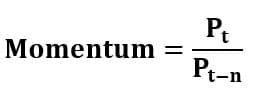
This formula yields a normalized value which oscillates around a baseline (commonly 1).
Interpretation
- Above 1: Indicates upward momentum, suggesting bullish conditions.
- Below 1: Indicates downward momentum, signaling bearish tendencies.
- At 1: Represents a neutral state, where prices have remained consistent over the time frame.
Key Components
- Time Period (n): The number of periods used in the calculation significantly impacts the indicator’s sensitivity. Shorter periods result in a more reactive oscillator, while longer periods smooth out fluctuations.
- Normalization: The ratio format ensures the indicator is easily comparable across different assets and time frames.
- Baseline: The midpoint (often 1) serves as a reference for identifying positive or negative momentum.
How to Create the Technical Indicator Using LC JS Trader
Step 1: Get LightningChart JS Trader
To begin, you’ll need access to LightningChart JS Trader. This library provides the tools necessary to create advanced technical indicators, including the Momentum Oscillator Indicator. Visit the LightningChart JS Trader page to download the required components and review the documentation.
Step 2: Review the Interactive Example
LightningChart JS Trader includes interactive examples that demonstrate how to create custom technical indicators. Start by reviewing the documentation, focusing on how to integrate the Momentum Oscillator Indicator into your chart setup. The interactive examples will guide you through the process of setting up the Momentum Oscillator Indicator, from importing the necessary modules to modify the chart settings.
Step 3: Code Explanation
In this step, we will break down the code that creates the chart with the Momentum Oscillator Indicator, as shown in the image, using LightningChart JS Trader. The code demonstrates how to initialize a trading chart, apply the Momentum Oscillator Indicator, and customize its appearance.

Here’s a detailed breakdown of each section:
A. Importing the Required Libraries:
   const lcjsTrader = require('@arction/lcjs-trader')
   const lcjs = require('@arction/lcjs')
const { Themes } = lcjs- lcjsTrader: This library provides access to the LightningChart JS Trader functionalities, allowing you to create advanced financial charts.
- lcjs: The main LightningChart JS library, used for general charting functionality.
- Themes: A property within lcjs that provides access to pre-built themes. In this case, we are using the darkGold theme to style the chart.
B. Initializing the Trading Chart:
   lcjsTrader.trader(TRADER_LICENSE).then(async (trader) => {
    // Create a trading chart.
const tradingChart = trader.tradingChart({ loadFromStorage: false, colorTheme: Themes.darkGold })trader(TRADER_LICENSE): Initializes the LightningChart JS Trader with the provided license key (TRADER_LICENSE). This is required to access the charting functionalities for financial data.
Note you can request a LightningChart JS Trader trial license, which is free.
tradingChart(): This function creates a trading chart with certain options.loadFromStorage: false: This disables the loading of previously stored chart data from local storage, ensuring a fresh chart setup.colorTheme: Themes.darkGold: This applies the darkGold theme to the chart, which influences the background color, gridlines, and other visual elements.
C. Adding and Customizing the Indicator
    // Add a Momentum Oscillator indicator
    const mo = tradingChart.indicators().addMomentumOscillator()
    mo.setPeriodCount(10)
    mo.setSource(3)
    mo.setLineColor('#E733FF')
mo.setLineWidth(3)addMomentumOscillator(): It compares the latest price to a price selected number of time periods ago. This version returns the normalized values, i.e. the ratio between the prices.
mo.setPeriodCount(10): Sets the number of time periods (n) used to calculate the indicator.
**mo.setSource(3): Sets which values the indicator calculations are based on. In this case, calculations based on Close values.
mo.setLineColor('#E733FF'): Changes the color of the IMI line to purple.
mo.setLineWidth(3): Sets the line thickness of the indicator to 3 pixels. This makes the line more prominent and easier to observe during analysis.
D. Loading Data from a CSV File
    // Reading data from a file.
    await fetch(`${document.head.baseURI}examples/assets/0000/Alphabet Inc (GOOGL).csv`).then((res) => res.text()).then((text) => {
        tradingChart.readCsvString(text, 'Alphabet Inc (GOOGL)')
})fetch(): This function retrieves a CSV file containing historical data for Alphabet Inc. (GOOGL). The CSV file includes pricing information for the company’s stock, which is plotted on the chart.readCsvString(): This function reads the CSV data and interprets it as pricing data for Alphabet Inc. The second argument (‘Alphabet Inc (GOOGL)’) sets the label for the chart, as seen at the top of the chart image.
E. Setting the Currency for the Chart
    tradingChart.setCurrency('USD')
})setCurrency('USD'): This sets the currency of the chart to USD, ensuring that the pricing data is interpreted and displayed in US dollars.
** Enumeration Source in LC JS Trader:
To select which values the indicator calculations are based on.

Advantages and Limitations of the Indicator
Advantages
- Ease of Use: The Momentum Oscillator’s simple calculation and interpretation make it accessible to traders of all experience levels.
- Versatility: It is applicable across various asset classes and trading styles, including intraday and swing trading.
- Trend Confirmation: The oscillator provides clarity in confirming ongoing trends and potential reversals.
- Integration with Other Indicators: It works seamlessly with complementary indicators like moving averages or the Relative Strength Index (RSI), enhancing trading strategies.
Limitations
- Lagging Nature: Like most oscillators, it may lag in rapidly changing markets, leading to delayed signals.
- False Signals: In highly volatile markets, it may generate misleading overbought or oversold readings.
- Subjectivity in Time Frames: The choice of n is crucial, as it can dramatically alter the oscillator’s behavior and effectiveness.
Conclusion
The Momentum Oscillator remains a cornerstone of technical analysis, empowering traders to measure and interpret price momentum with precision. By understanding its history, mechanics, and practical applications, traders can incorporate this powerful indicator into their strategies.
For those looking to elevate their trading strategies, mastering the Momentum Oscillator using LightningChart JS Trader is an essential step toward gaining a competitive edge in the market. LightningChart JS Trader offers highly interactive and customizable charting solutions, enabling traders to:
- Seamlessly integrate technical indicators into their workflows.
- Visualize Momentum Oscillator data in real-time with unparalleled clarity.
- Leverage advanced charting features to better interpret market trends and signals.
By combining the power of the Momentum Oscillator with the intuitive and dynamic capabilities of LightningChart JS Trader, traders can enhance their analytical precision and make more informed decisions.
Continue learning with LightningChart
High-Performance Charting Controls for Fintech App Development
Written by a human | Updated on April 10th, 2025Charting Controls for Fintech Apps Money makes the world go round and as such, tracking and controlling financial transactions and information are some of the most important activities to do for any...

Data Visualization in Medical & Healthcare Applications
Written by a human | Updated on April 10th, 2025Charting Controls for Medical Healthcare Data Visualization Applications The fact that data and data visualization are everywhere in today's world, makes me wonder how data visualization impacts medical...
Creating a Smith Chart Application in .NET
Written by a human | Updated on April 9th, 2025Smith Charts The Smith chart is a diagram designed for the study and resolution of problems with transmission lines. This diagram is aimed at electrical and electronic engineers specializing in radio frequency....



If you have any questions, feel free to contact us!
©LightningChart Ltd 2025. All rights reserved.